
TL;DR: Most 1-3 truck residential electrical shops should be on QuickBooks Online Simple Start ($30/mo) plus Gusto Core (~$40/mo), about $70/mo all-in, and shouldn't touch Knowify or BuildOps yet. About 60% of US small businesses still run on QuickBooks (Intuit Q3 FY2024 earnings, 2024). The upgrade to trade-specific accounting earns its keep around 5-10 trucks, when job costing on multi-week projects starts deciding whether you're profitable.
Most "best accounting software for electricians" articles tell you to buy. This one tells most shops not to. We've sat in on dozens of small-shop conversations about what runs the books, and the pattern is the same every time: a 2-truck shop on QuickBooks Online Simple Start does not need Knowify, BuildOps, or ServiceTitan. The shop that does is usually running 5-plus trucks, doing multi-week residential remodels with progress billing, and losing money on jobs the owner can't see clearly.

This is the buyer's guide for that decision. Three categories of electrician software handle the books: general-purpose accounting (QuickBooks, Xero, FreshBooks, Wave), trade-specific accounting (Knowify, Sage 100 Contractor), and field service management with accounting bolted on (BuildOps, ServiceTitan, Housecall Pro, Jobber). Below is the stage-based recommendation, the honest total-cost-of-ownership math, and the carve-out from invoicing software that nobody else in the search results draws.
A quick disclosure: We build bench-side software for electricians (NEC reference, load calculations, line diagrams) and do not sell accounting, payroll, or FSM software. We take no affiliate fees from any vendor in this guide. Pricing was verified on vendor pricing pages and sales calls in June 2026. SaaS pricing drifts, so re-verify before purchase.
Books vs getting paid on one job, two different tools. If you're here because invoices keep slipping past 30 days and you want to send a quote on your phone and collect payment by Friday, you want the electrician invoicing software guide. That piece is about one transaction at a time. This piece is about the year-round system: payroll, expense tracking, sales tax, and the file you hand your CPA in April. Most shops need both, layered. They are not the same software.
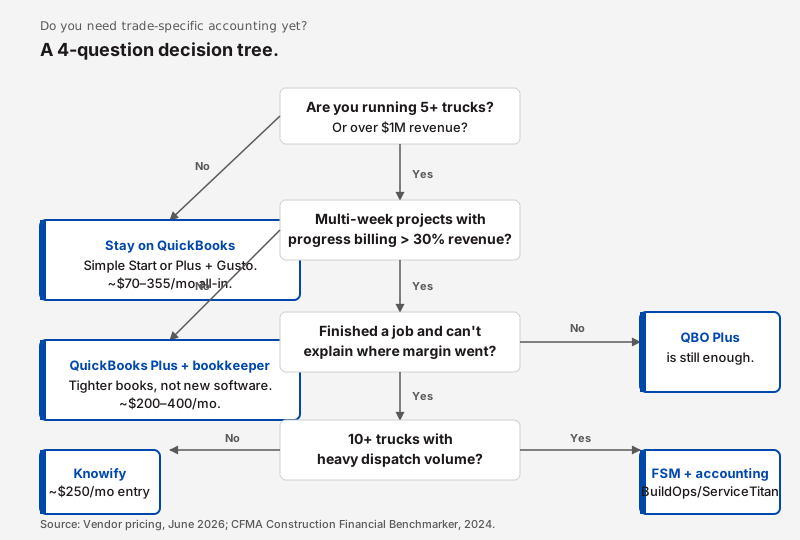
Do you actually need electrician accounting software yet?
If you run one truck and your gross revenue is under about $300,000, the honest answer is no, you need QuickBooks Online Simple Start ($30/mo) and a CPA, and that's the whole system. Roughly 73% of US construction firms have fewer than 5 employees (Census County Business Patterns NAICS 23, 2022, 2022). At that size, the spend on trade-specific software pays back negative.
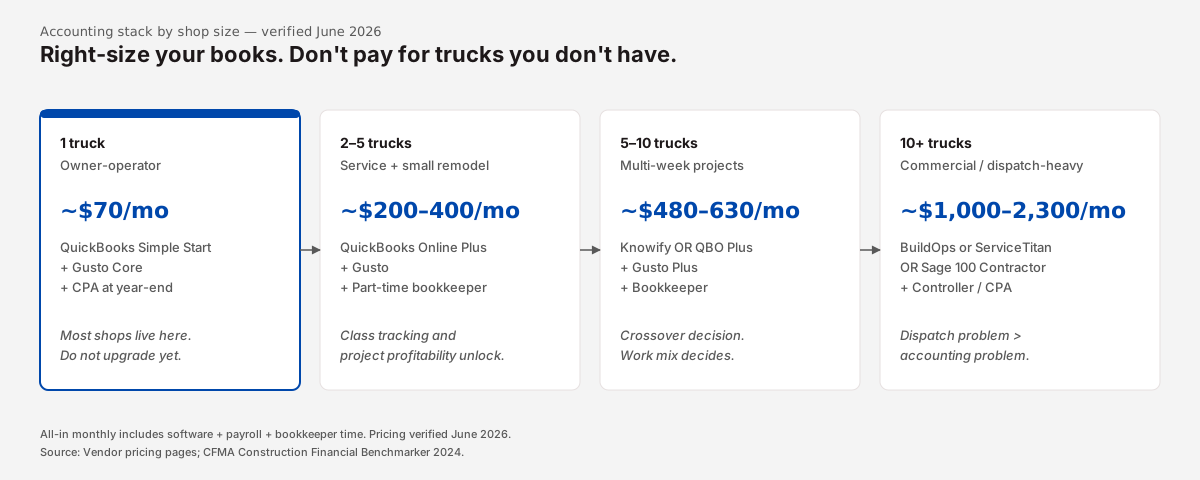
Here's the decision tree by shop size.
- 1 truck, owner-operator. QuickBooks Online Simple Start ($30/mo) plus Gusto Core (~$40/mo). About $70 a month, your CPA handles year-end, and you don't need anything else. If your spouse does the books, that's already the budget.
- 2 to 5 trucks. QuickBooks Online Plus ($99/mo) plus Gusto ($40-80/mo) plus a part-time bookkeeper (5-10 hours a month). About $200-400/mo all-in. The Plus tier unlocks class tracking and project profitability, enough job costing for most residential service work.
- 5 to 10 trucks, multi-week project work. This is the crossover. When you're running 3-week residential remodels or first commercial service contracts with progress billing, QuickBooks Plus project tracking starts breaking down. Knowify ($250/mo) or staying on QuickBooks Plus with a tighter bookkeeper are both legitimate answers. The deciding factor is how often you finish a job and realize you lost money you can't trace.
- 10-plus trucks. Field service management with accounting integration (BuildOps, ServiceTitan) or Sage 100 Contractor with a full-time controller. You're past where part-time bookkeeping holds up.
Stat callout, you probably don't need Knowify yet. Among small construction shops under 5 employees, fewer than 1 in 5 run trade-specific accounting software. Most stay on QuickBooks Online or Xero plus a CPA, and the data on margin doesn't show those shops being any less profitable than the ones who paid up. Source: CFMA Construction Financial Benchmarker, 2024.
The carve-out matters here. If your real problem is "I send an invoice and it sits for 45 days," accounting software won't fix that, see the electrician invoicing software guide for the side of the problem that's about one transaction at a time, ACH versus card, and payment links. Accounting software is for the year-round picture: every dollar in, every dollar out, payroll, and the clean handoff to your CPA in April.
What are the three categories of electrician accounting software?
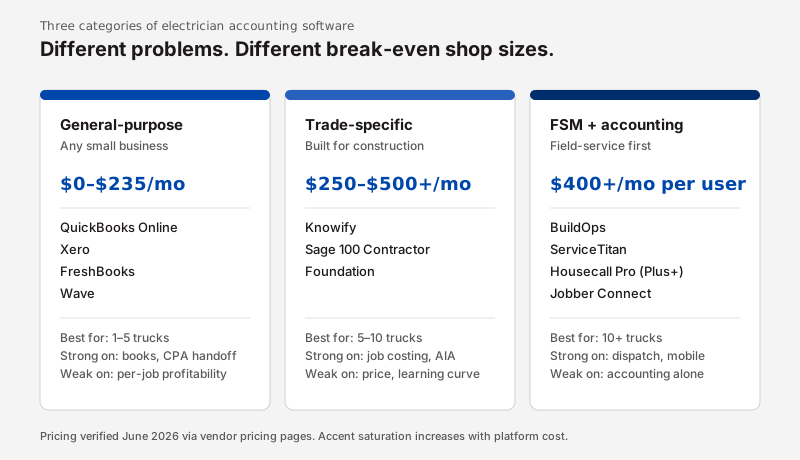
Electrician accounting software splits into three categories: general-purpose accounting (the QuickBooks tier), trade-specific accounting built for construction (the Knowify tier), and field service management with accounting features bolted on (the BuildOps tier). About 80% of small contractors use QuickBooks or a similar general-purpose tool (Intuit small business report, 2024, 2024). Each tier solves a different problem and has a different break-even shop size.
General-purpose accounting ($0-$235/mo). QuickBooks Online (Simple Start, Essentials, Plus, Advanced), Xero, FreshBooks, and Wave. Built for any small business, not specifically for contractors. Strong on basic books, payroll integration, and CPA handoff. Weak on per-job profitability, progress billing, and certified payroll. The right answer for 1-5 truck shops.
Trade-specific accounting ($250-$500+/mo). Knowify, Sage 100 Contractor, and Foundation. Built specifically for construction. Strong on job costing per work order, AIA progress billing, change orders, certified payroll for prevailing-wage work, and committed-cost tracking. Weak on price, the cheapest of these is roughly 3x what QuickBooks Plus costs. The right answer at 5-10 trucks if you're running multi-week projects, or sooner if you do any commercial work.
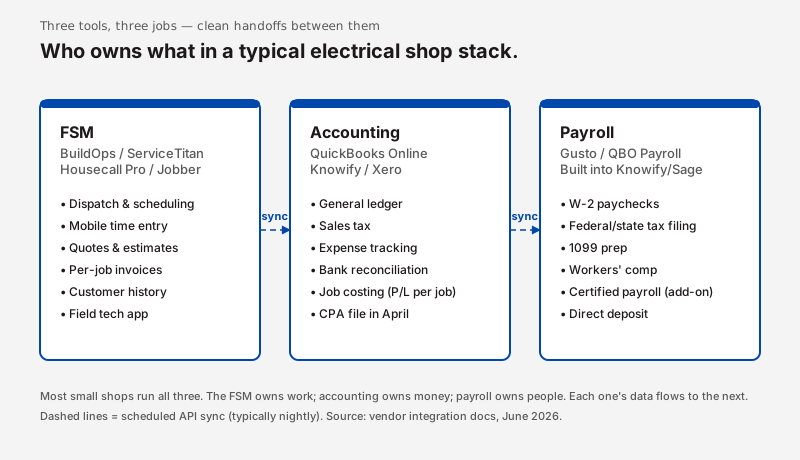
FSM with accounting ($400+/mo). BuildOps, ServiceTitan, Housecall Pro (Plus tier and up), and Jobber Connect. These are field service management platforms first. Accounting is a feature, and most still sync the actual books out to QuickBooks for CPA handoff. Strong on dispatch, mobile time entry, and full operations from quote to invoice. Weak as primary accounting if you're not also using the FSM side. Don't buy these for the accounting alone, you're paying $400+ for software you'd buy at $0-30 if it were unbundled.
Which accounting software should you buy at your shop size?
Buy the cheapest tier that covers your actual bottleneck. For most residential electrical shops under 5 trucks, that's QuickBooks Online Plus ($99/mo) plus Gusto. The data on profitability doesn't show that shops who upgrade earlier do better, they just spend more on software (CFMA Construction Financial Benchmarker, 2024, 2024). Software does not run the business; the books, payroll, and CPA handoff do.
Here's the stage-by-stage answer, with the crossover trigger that tells you when to move up a tier.
1 truck → QuickBooks Online Simple Start + Gusto Core. Total around $70/mo. The Simple Start tier handles invoicing, expense tracking, sales tax, and 1099 prep. Gusto Core covers payroll for up to 10 employees at $40 plus $6 per person. Your CPA exports the QuickBooks file in April and you're done. Crossover trigger: when you hire your second tech and start needing class tracking by job, move to QuickBooks Online Plus.
2 to 5 trucks → QuickBooks Online Plus + Gusto + bookkeeper. Total $200-400/mo. QuickBooks Plus ($99/mo) adds project profitability, class tracking, and budgets, enough job costing for residential service and small remodel work. A part-time bookkeeper at 5-10 hours a month catches the things you're missing on receipts and reconciliations. Crossover trigger: when you're running 3-plus jobs simultaneously, each lasting 2-plus weeks, with progress billing, and the QuickBooks project view stops giving you a clean profit number per job.
5 to 10 trucks → Knowify or stay on QuickBooks Plus. This is the most contested decision in the category. Knowify ($250/mo entry) gives you proper construction job costing, change order tracking, AIA progress billing, and certified payroll. It also gives you a 6-8 week implementation and a learning curve. If multi-week residential remodels or any commercial work makes up more than 30% of your revenue, the upgrade pays. If you're still mostly service work plus the occasional panel upgrade, stay on QuickBooks Plus with a better bookkeeper. Crossover trigger: you finish a job and realize you lost money on it that you cannot explain from the QuickBooks reports.
10-plus trucks → FSM with accounting integration or Sage 100 Contractor. BuildOps and ServiceTitan run $400-700/mo per user typically, often more. Sage 100 Contractor lands around $500/mo and assumes a controller or contracted CPA. The decision here is whether your bottleneck is dispatch (FSM wins) or contract-level accounting (Sage 100 wins). Most 10-truck shops we've watched ended up on FSM-with-accounting because the dispatch problem is bigger than the accounting problem.

We've watched shops upgrade to Knowify at 4 trucks and regret the $250/mo until they hit 7 or 8 and the job costing finally started telling them something they didn't already know. We've also watched 8-truck shops stay on QuickBooks Plus successfully, with a tight bookkeeper running clean P&Ls by job. Shop size is the rough guide. The specific work mix is the actual decider.
What does it actually cost? The full TCO by shop size
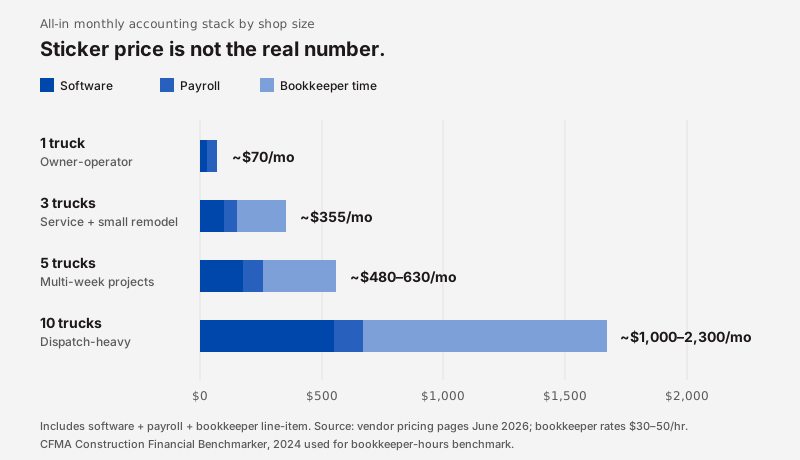
Sticker price is not the real number. The honest total-cost-of-ownership math includes software, payroll add-on, and bookkeeper time. About 40% of small contractors underestimate their bookkeeping spend by more than half because they forget the hours their spouse or office manager puts in (NFIB Small Business Economic Trends survey, Q1 2024, 2024). Once you include payroll and labor, the cheap tier is rarely as cheap as the website says, and the expensive tier is rarely as expensive.
| Shop size | Software | Payroll | Bookkeeper | All-in monthly |
|---|---|---|---|---|
| 1 truck | QuickBooks Simple Start, $30 | Gusto Core, ~$40 | Owner / spouse | ~$70 |
| 3 trucks | QuickBooks Plus, $99 | Gusto Core, ~$55 | Part-time, ~$200 | ~$355 |
| 5 trucks | QuickBooks Plus or Knowify, $99-$250 | Gusto Plus, ~$80 | Part-time, ~$300 | ~$480-$630 |
| 10 trucks | FSM-with-accounting, $400-$700 | Included or Gusto, ~$120 | Bookkeeper / controller, ~$500-$1,500 | ~$1,000-$2,300 |
Stat callout, the 1-truck-to-5-truck jump. Going from 1 truck to 5 trucks roughly multiplies your monthly accounting-stack spend by 7x ($70 to ~$500). Going from 5 to 10 trucks roughly doubles it again. The math says: don't pay for the 5-truck stack until you have the 5-truck revenue to absorb it.
The hidden costs that wreck this math:
- Implementation and training, one window. Knowify is roughly 6-8 weeks end to end if you have a bookkeeper driving it, covering both software setup and getting the office trained on entering time, expenses, and job codes correctly. Longer if not. BuildOps and ServiceTitan run 60-90 days. During that window, you're paying for the new system and not yet getting the value.
- The bookkeeper line item. A part-time bookkeeper at $30-50/hr for 5-10 hours a month is often the deciding cost of the whole stack. Skipping it is the most common mistake, and it shows up at year-end when the CPA bills you 2x to clean things up.
What do general-purpose accounting tools actually do?
General-purpose accounting tools, QuickBooks Online, Xero, FreshBooks, and Wave, handle the books for any small business, not specifically for contractors. They cost $0-$235/mo and cover invoicing, expense tracking, bank reconciliation, sales tax, basic payroll integration, and a clean export to your CPA. About 80% of US small contractors run on QuickBooks (Intuit Q3 FY2024 earnings, 2024, 2024). It is the gravity well of the category for a reason.
QuickBooks Online. The anchor. Four tiers as of June 2026: Simple Start ($30/mo), Essentials ($60/mo), Plus ($99/mo), Advanced ($235/mo). For electricians, the meaningful breakpoint is Plus, it adds project profitability and class tracking, which is what passes for job costing in QuickBooks. Below Plus, you cannot run clean per-job P&Ls. Above Plus, you're paying for multi-user controls and custom reporting most shops never use. Pair with QuickBooks Payroll or Gusto.
Xero. The QuickBooks alternative. Three tiers as of June 2026: Early ($15/mo), Growing ($47/mo), Established ($80/mo). Clean interface, strong bank reconciliation, weaker on contractor-specific features. The Early tier caps you at 20 invoices a month, which knocks out most service-work shops. If you're switching from QuickBooks, the CPA familiarity argument usually wins for QuickBooks anyway, most US small-business CPAs work in QuickBooks daily and have to relearn Xero.
FreshBooks. Best for true solo operators. Plus tier at $35/mo. Strong invoicing, time tracking, and proposal workflow, built for service businesses billing by the hour or per project. Weak as a real accounting system as you grow past one or two people. Most shops on FreshBooks at 2-plus trucks would be better served switching to QuickBooks Simple Start.
Wave. Free for accounting and invoicing. Payments and payroll cost extra. Honest answer when it's enough: 1-truck owner-operator, fewer than 5 invoices a month, doing your own books. Honest answer when it isn't: as soon as you hire your first employee or hit 10 invoices a month, the missing reporting and the awkward CPA handoff start costing more than the saved $30/mo.
What do trade-specific accounting tools actually do?
Trade-specific accounting, Knowify, Sage 100 Contractor, Foundation, adds construction job costing, AIA progress billing, change orders, committed-cost tracking, and certified payroll on top of basic accounting. They cost $250-$500+/mo. Contractors who track job-level profitability run roughly 2-3 percentage points better gross margin than those who don't (CFMA Construction Financial Benchmarker, 2024, 2024). At 5-plus trucks, that margin gap covers the price tag. Below 5 trucks, it usually doesn't.
The differentiator is job costing, real job costing, not the project profitability feature in QuickBooks Plus. Real job costing means every labor hour, every receipt, every committed purchase order, and every change order roll up to a per-job P&L you can see while the job is still open. QuickBooks Plus does a decent approximation for short residential service work. It breaks down at 2-plus weeks per job with progress billing.

Knowify. The most common step-up from QuickBooks. As of June 2026, pricing starts around $250/mo for the entry tier (Office) and runs higher with field add-ons. Tight QuickBooks Online sync, Knowify owns job costing and project workflow, QuickBooks Online still owns the general ledger and CPA handoff. The right answer for 5-10 truck residential shops doing remodel work, or any shop starting to take on small commercial contracts.
Sage 100 Contractor. Heavier, accountant-led, more capable. Pricing runs around $500+/mo and assumes a controller or contracted CPA who knows Sage. Strong on payroll, certified payroll, AIA billing, and committed-cost tracking. The right answer at 10-plus trucks when the dispatch problem is small but the contract-accounting problem is large. Not the right answer if your bookkeeper has never seen Sage.
Foundation. Briefly: enterprise-grade construction accounting. Mostly out of scope for residential electrical shops. If you're considering Foundation, you have a controller already and they're driving the decision.
What about FSM platforms with accounting built in?
These are not really accounting software. BuildOps, ServiceTitan, Housecall Pro (Plus and up), and Jobber Connect are field service management platforms that include accounting features and sync the books out to QuickBooks for CPA handoff. They cost $400+/mo per user typically. The math only works at 10-plus trucks, when the dispatch and mobile-time problems are big enough to justify the FSM tier. About 25% of mid-size contractors are now on integrated FSM-with-accounting platforms (CFMA Construction Financial Benchmarker, 2024, 2024).
The trap is paying $400+/mo for FSM you don't actually need just to get the integrated accounting. If your real bottleneck is dispatch, see the electrician scheduling software guide, then FSM-with-accounting earns its keep. If your real bottleneck is customer history and follow-up, an electrician CRM solves that more cheaply. If your bottleneck is the books themselves, you're paying for software you don't need.
| Tool | Starting price | Real role | Accounting role |
|---|---|---|---|
| BuildOps | ~$400/mo per user | Commercial service FSM | Syncs to QuickBooks; some native AR/AP |
| ServiceTitan | ~$398+/mo per user | Residential + commercial FSM | Native accounting, optional QuickBooks sync |
| Housecall Pro (Plus) | ~$150-$300/mo | Residential service FSM | QuickBooks sync, no native GL |
| Jobber Connect | ~$229/mo | Residential service FSM | QuickBooks/Xero sync, no native GL |
For most shops, the cleanest pattern is FSM for dispatch and customer history, QuickBooks for the actual general ledger, and Gusto for payroll. Three tools, three jobs, clean handoffs between them.
How do payroll and CPA handoff actually work?
Your accounting software is usually not your payroll software. Most electrical shops run Gusto or QuickBooks Payroll regardless of which accounting backbone they chose. About 65% of US small businesses use a third-party payroll service (NFIB Small Business Economic Trends survey, Q4 2023, 2023). The stack matters more than any single piece of it.
Payroll: pick one and stop shopping.
- Gusto Core ($40/mo + $6/employee). The default answer for 1-10 employee shops. Clean interface, easy onboarding, handles federal and state tax filing. Pairs with QuickBooks, Xero, Knowify, and most FSMs. Gusto Plus ($80/mo + $12/employee) adds next-day direct deposit and time tracking that matters once you're at 5-plus techs.
- QuickBooks Payroll ($50-$130/mo). The same-system pick. If you're on QuickBooks already, QuickBooks Payroll is the path of least resistance. Less polished than Gusto, more deeply integrated with the books.
- Knowify Payroll. Built in. Reasonable for 5-10 truck Knowify shops; usually still paired with Gusto for the actual filing.
For any prevailing-wage work (commercial, government, or union contracts), you need certified payroll. Knowify and Sage 100 Contractor handle it natively. Gusto handles it via add-on. QuickBooks Online does not, you'd export to a separate tool. Workers' comp tracking is a similar story: Gusto and ADP do it, QuickBooks Online does not natively.
CPA handoff: QuickBooks is the gold standard.
Your CPA's job in April is to take your books, file the return, and not bill you a fortune for cleanup. The cleaner the handoff, the lower the bill. QuickBooks export is the format every US small-business CPA already knows. Xero is a close second. Knowify syncs back to QuickBooks before CPA season, so the handoff still happens in QuickBooks. Sage 100 Contractor exports clean files but assumes the CPA knows Sage. BuildOps and ServiceTitan vary, confirm with your CPA before you switch.
The handoff your CPA actually wants: a clean QuickBooks Online file, reconciled bank and credit card accounts, every receipt classified, and a 1099 vendor list ready to go. None of that is software-dependent. The software just makes it easier or harder.

The 6-tool comparison at a glance
Below is the buyer's table the top Google results don't cleanly provide. Pricing reflects publicly listed plans as of June 2026 and should be re-verified before purchase. Job costing grade is our judgment based on how the tool actually handles per-job profitability for electrical work, not vendor marketing.
| Tool | Starting price | Best for | Job costing | Payroll | CPA export | Verdict |
|---|---|---|---|---|---|---|
| QuickBooks Online Plus | $99/mo | 2-5 truck residential | C+ (project profitability) | QBO Payroll or Gusto | Gold standard | Default pick; upgrade trigger is multi-week projects |
| Xero Growing | $47/mo | 1-3 truck, non-QBO preference | C (basic projects) | Gusto | Strong | Switch from QBO only if CPA agrees |
| FreshBooks Plus | $35/mo | True solo, billing-heavy | C- (time/proposal focus) | Gusto | OK | Don't grow past 2 trucks on this |
| Knowify Office | ~$250/mo | 5-10 truck remodel + small commercial | A (real construction job costing) | Built-in or Gusto | Via QBO sync | The Knowify-or-not crossover sits here |
| Sage 100 Contractor | ~$500/mo | 10+ truck commercial-leaning | A (committed cost + AIA) | Built-in, certified payroll | Strong with Sage-friendly CPA | Controller required |
| BuildOps | ~$400+/mo per user | 10+ truck commercial service | B+ (FSM-driven) | Built-in or Gusto | Via QBO sync | Buy for dispatch, not for accounting |
The takeaway: QuickBooks Online Plus is the default for 90% of small electrical shops. Knowify is the upgrade when multi-week projects and progress billing start hiding losses. Everything else is shop-size-specific.
If you want a free starting point that doesn't touch the books at all, the Breakerbox load calculator handles the technical side of every quote and integrates nowhere, which is the right answer for a shop that hasn't picked its accounting stack yet.
Frequently Asked Questions
Does QuickBooks work for electricians?
Yes, QuickBooks Online Plus ($99/mo) is the most common backbone for electrical shops under 10 trucks. About 80% of US small contractors run on QuickBooks (Intuit Q3 FY2024 earnings, 2024, 2024). The Plus tier adds project profitability and class tracking, which covers job costing for residential service work. It falls short on AIA progress billing and certified payroll.
What's the difference between accounting software and field service software?
Accounting software handles the books: every dollar in and out, payroll, sales tax, and the CPA handoff. Field service software handles the work: dispatch, mobile time entry, quotes, and invoicing per job. About 25% of mid-size contractors run both as one integrated platform (CFMA Construction Financial Benchmarker, 2024, 2024). Most small shops keep them separate: QuickBooks plus an FSM, with sync between them.
Do I need Knowify or is QuickBooks enough?
For shops under 5 trucks doing mostly service work, QuickBooks Online Plus plus Gusto is usually enough, about $200-400/mo all-in. Knowify ($250/mo) earns its $250 when you're running multi-week residential remodels with progress billing, or starting to take small commercial contracts. The crossover question: do you finish jobs and not know why one lost money? If yes, upgrade.
How much does electrical contractor accounting software cost?
Real total-cost-of-ownership runs about $70/mo for a 1-truck shop (QuickBooks Simple Start plus Gusto), $355/mo for a 3-truck shop (QuickBooks Plus plus part-time bookkeeper), $480-$630/mo for a 5-truck shop (QuickBooks Plus or Knowify plus Gusto Plus plus bookkeeper), and $1,000-$2,300/mo for a 10-truck shop on FSM-with-accounting. About 40% of small contractors underestimate this spend (NFIB Small Business Economic Trends survey, Q1 2024, 2024).
What accounting software has the best payroll for contractors?
For most small electrical shops, the answer is Gusto Core ($40/mo + $6/employee) paired with whatever accounting backbone you've chosen. Knowify Payroll and Sage 100 Contractor handle certified payroll natively for prevailing-wage work. About 65% of small businesses use a third-party payroll service rather than relying on built-in features (NFIB Small Business Economic Trends survey, Q4 2023, 2023).
The short version
A few things worth remembering when you go shop:
- Most 1-3 truck shops should stay on QuickBooks Online Simple Start or Plus plus Gusto, $70-$355/mo all-in, and not touch trade-specific software yet.
- Knowify and the trade-specific tier earn the $250+/mo at 5-10 trucks when multi-week projects with progress billing start hiding losses on the QuickBooks reports.
- FSM-with-accounting (BuildOps, ServiceTitan) is for 10-plus truck shops where dispatch is the real bottleneck. Don't buy it for the accounting.
- Gusto plus QuickBooks is the default payroll-plus-accounting stack regardless of size; CPA handoff is cleanest in QuickBooks.
- Pick by shop size and work mix, not by which vendor called you first.
For the broader category map of every software an electrical shop might run, see the electrician software guide. For the invoicing-and-payments side that this guide deliberately does not cover, the electrician invoicing software guide is the companion piece. If you want a free starting point that doesn't touch your books at all, the Breakerbox load calculator handles the technical side of every quote.