
If you searched "load calculation" looking for HVAC sizing, you want Manual J. This guide covers the other one. We walk through how to do a load calculation under NEC Article 220. The result decides whether the service stays at 100A, jumps to 200A, or moves to 320/400A class. It drives the next inspection.
TL;DR: A residential electrical load calculation totals connected and demand loads under NEC Article 220 (2023), then converts the result to amps so you can size the service. This guide runs a real 2,000 sq ft house through both the Standard Method (220 Parts II–IV) and the Optional Method (220.82) side by side, then drops you into the Breakerbox Load Calculator to run your own numbers. The 3 VA/sq ft general lighting rule (NEC 220.12) and the 1,500 VA per small-appliance and laundry circuit rule (NEC 220.52) are the backbone of both methods.
A quick disclosure: This guide reflects the 2023 NEC. Where the 2017 or 2020 cycle differs on a rule that matters here, the delta is noted inline. Your AHJ might still be on the 2020 cycle, so confirm the adopted code in your jurisdiction before you stamp anything. I'm Jack Simpson, co-founder at Breakerbox and an electrical engineer. I have run residential load calcs under the 2017, 2020, and 2023 cycles. We make the Breakerbox Load Calculator.
What is an electrical load calculation?
An electrical load calculation is a structured tally of every connected and demand load in a dwelling, expressed in volt-amps (VA), that gets converted to amperes so you can size the service-entrance conductors, the main OCPD, and (sometimes) feeders to subpanels. It lives in NEC Article 220, which the 2023 cycle organizes into five parts: general (I), branch-circuit (II), feeders and services (III), optional methods (IV), and farm calcs (V).
Two things are worth getting straight up front. First, "load calculation" in the electrical world is not Manual J or Manual D. Those are HVAC. This calc gets you the service size. Second, the calc isn't optional. The AHJ wants it on the permit, the POCO wants it before they upsize the drop, and the homeowner's insurance carrier is going to want it the day a 100A panel catches fire because somebody added an EV charger and a heat pump without one.
For the full Article 220 walkthrough, the NEC Article 220 reference guide digs into each Part. This page is the method, top to bottom, with the numbers.
When do you actually need to run one, and which method applies?
You run a load calc any time you're building new, upgrading the service, adding a major load (EV charger, heat pump, electric range), or pulling a permit for anything the AHJ flags as load-affecting. In practice the trigger list is shorter than people think: new construction, service change, sub-panel add, or any branch circuit over ~30A continuous.
For dwellings, you have a choice between two NEC methods, and the eligibility rules are tight.
| Trigger | Calc required? | Usual method |
|---|---|---|
| New single-family build | Yes | Optional (220.82) most often |
| Service upgrade (100A to 200A, etc.) | Yes | Optional or Standard, AHJ choice |
| Adding 40A+ EV charger | Yes (NEC 625.42) | Optional 220.83 (add-load existing dwelling) |
| Adding heat pump or strip heat | Yes | Optional or Standard |
| New solar/PV interconnection | Yes (705.12) | Standard (PV affects busbar calc, not the load calc itself) |
| Replacing a like-for-like load | No | n/a |
| Multifamily or commercial | Yes, separate rules | Out of scope here; see commercial load calculations |
The Optional Method (NEC 220.82, 220.83, 220.84) is restricted to dwelling units served by a single 120/240V, 3-wire service or feeder. If you're sizing for a duplex on a single service, an apartment building, or a commercial occupancy, you're in the Standard Method or you're in Part IV's specialty calcs. Don't try to force Optional on anything it doesn't fit, because it'll fail plan review.
How do you do a load calculation, step by step?
Here is the seven-step method an electrician runs in the field. It works for either method; the difference is which demand factors you apply at step 5.
- General lighting and receptacle load. Multiply finished square footage by 3 VA/sq ft (NEC 220.12, 2023). Same rule under 2017 and 2020. Don't include unfinished basement, attached garage, or unfinished attic. A 2,000 sq ft house gives you 6,000 VA right there.
- Small-appliance and laundry circuits. Count two small-appliance circuits minimum (kitchen) at 1,500 VA each, plus one laundry circuit at 1,500 VA (NEC 220.52). That's 4,500 VA floor before you touch a single appliance nameplate.
- Fixed-appliance and equipment nameplate loads. Range, oven, cooktop, dishwasher, disposal, water heater, dryer, microwave (if dedicated), wall heaters, well pump, pool pump. Use nameplate VA or watts (assume PF=1 unless the nameplate says otherwise). The range gets a special demand under 220.55 in the Standard Method; in Optional you just use nameplate.
- HVAC: heating vs cooling, take the larger. NEC 220.60 says you only count the largest of two non-coincident loads. A 4-ton AC compressor (about 4,800 VA running) and a 24kW electric furnace will not run at the same time, so you take the furnace. A heat pump with electric strip heat at lockout temperature is a wrinkle, addressed in the electrification section.
- Apply demand factors. This is where Standard and Optional diverge. Standard uses Table 220.42 for general lighting (100% of first 3,000 VA, 35% of next 117,000), Table 220.55 for ranges, Table 220.54 for dryers, and NEC 220.53 for four or more fixed appliances (75% factor). Optional Method 220.82 lumps the whole "other loads" bucket into a single demand factor: 100% of the first 10,000 VA, then 40% of everything over. The demand factor reference breaks every table down.
- Apply the 125% continuous-load rule where it lands. NEC 215.3 and 230.42 require continuous loads (3+ hours, like EV charging) to be sized at 125% of the load. The Optional Method already accounts for this in the all-in demand factor, but the Standard Method doesn't, so EV charger calcs at 125% bite under Standard.
- Convert demand VA to amps and round up. Demand VA ÷ 240V = service amps. Round up to the next standard OCPD/service rating: 100, 125, 150, 200, 320 (400-class), 400. Anything under 100A on a new build is going to look weird to a plan reviewer in 2026 with electrification on the horizon; 200A is the floor most shops are quoting.
Self-contained answer: What is the 3 VA per square foot rule? NEC 220.12 (2023) requires a general lighting and receptacle load of 3 VA per square foot of finished dwelling space for residences. It covers all general-use receptacles and lighting outlets that aren't on a dedicated circuit. A 2,000 sq ft house has 6,000 VA of general lighting load before anything else is added. The figure is unchanged from the 2017 and 2020 cycles.
Standard Method vs Optional Method: which one should you use?
Most residential electricians I know reach for the Optional Method first on dwellings. It's faster, the math is friendlier, and it gives you a smaller demand number on most retrofits because of the 40% factor on loads over 10,000 VA. The Standard Method wins when the house is loaded with continuous-duty equipment (commercial-style ranges, multiple HVAC zones, electric resistance heat) where the per-load demand tables in Part III beat 220.82's all-in factor.
| Dimension | Standard Method (220 Parts II–IV) | Optional Method (220.82) |
|---|---|---|
| Eligibility | Any dwelling | Dwelling on single 120/240V service, 100A minimum |
| Demand factor approach | Per-load tables: 220.42 (lighting), 220.54 (dryer), 220.55 (range), 220.53 (fixed appliances) | Single tiered factor: 100% of first 10,000 VA, 40% of remainder |
| HVAC handling | Larger of heat or AC, then 100% (no demand reduction) | Same: larger of heat or AC, at 100% |
| EV/large continuous loads | Must add 125% per 215.3 | Already baked into 40% demand factor |
| Inputs needed | Every nameplate, every circuit, every demand-factor lookup | Square footage, small-appliance count, nameplate totals |
| Time to run | 20–40 min by hand on a typical house | 10–15 min by hand |
| When it wins | Heavy electric-resistance heat, commercial-grade equipment, multiple HVAC units | Most new builds, most service upgrades, most retrofits |
Bottom line: run Optional first on any single-family dwelling. If the result puts you uncomfortably close to a service-size bump (say, 195A on a 200A service), re-run Standard. The two methods can land 10–20% apart on the same house, and on a borderline calc that's the difference between sticking at 200A and going to a 320-class meter base.
For a second worked example on a different house, the full residential walkthrough runs a 2,500 sq ft Optional Method calc end to end.
Worked example: a 2,000 sq ft house through both methods
Here are the inputs. Lock these before reading the math, because both methods run on the exact same house.
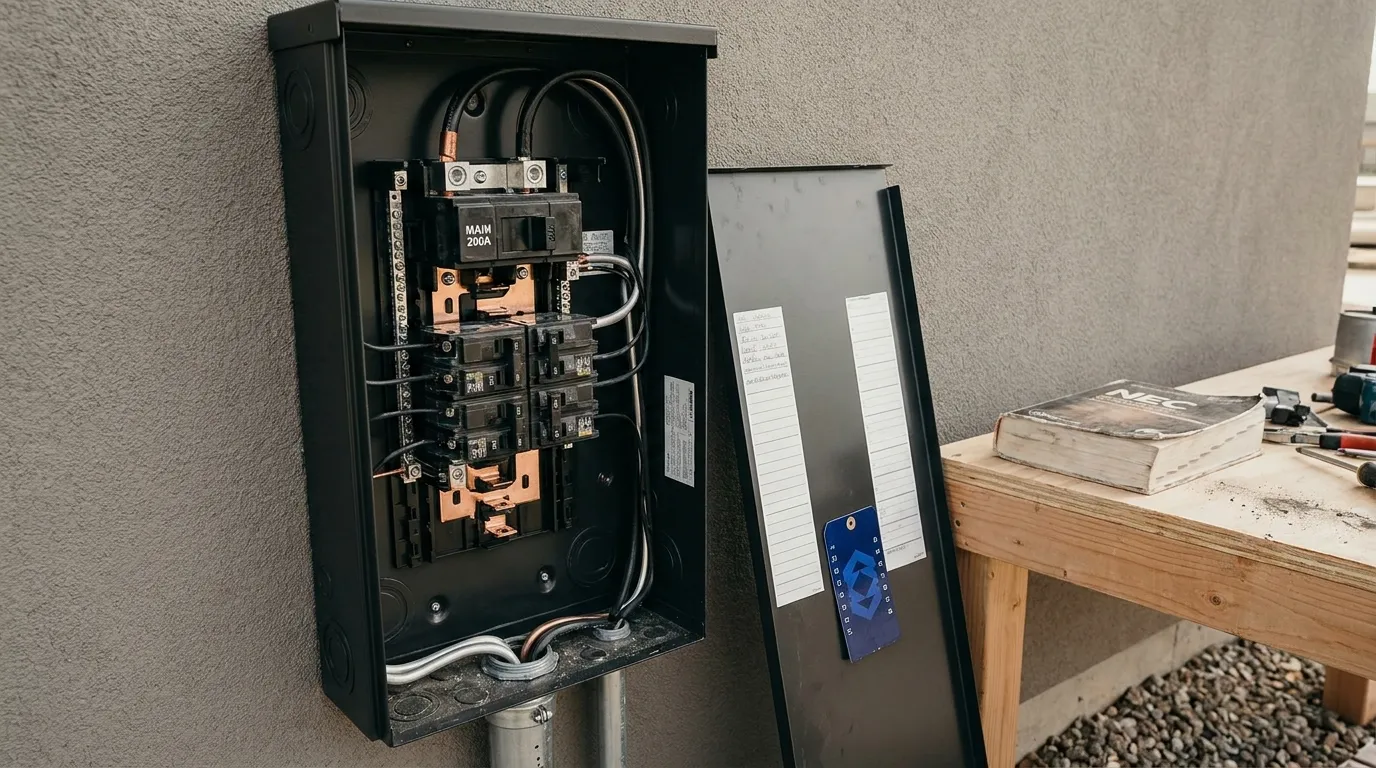
House inputs (used for both methods):
- Finished living area: 2,000 sq ft
- Small-appliance branch circuits: 2 (kitchen) at 1,500 VA each
- Laundry branch circuit: 1 at 1,500 VA
- Electric water heater: 1 × 40-gallon, 4,500 W (nameplate)
- Electric dryer: 5,000 W (5 kW nameplate)
- Electric range: 12,000 W (12 kW nameplate, single unit)
- Garbage disposal: 1.5 HP, ~1,100 VA (running)
- Dishwasher: 800 W
- Central AC compressor: 4-ton, 4,800 VA running load
- Electric furnace (strip heat): 24,000 W (24 kW)
- Service voltage: 120/240V single-phase
We'll run the Standard Method first because it surfaces every demand factor, then the Optional Method to compare.
Standard Method walkthrough
| Load category | NEC ref | Raw VA | Demand factor | Demand VA |
|---|---|---|---|---|
| General lighting (2,000 × 3 VA) | 220.12 | 6,000 | First 3,000 @ 100%, next 3,000 @ 35% (Table 220.42) | 3,000 + 1,050 = 4,050 |
| Small-appliance (2 × 1,500) | 220.52(A) | 3,000 | Bundled with lighting at 220.42 | (included in lighting demand) |
| Laundry (1 × 1,500) | 220.52(B) | 1,500 | Bundled with lighting at 220.42 | (included in lighting demand) |
| Lighting + small-appliance + laundry combined | 220.42 | 10,500 | First 3,000 @ 100%, next 7,500 @ 35% | 3,000 + 2,625 = 5,625 |
| Electric range (12 kW, single unit) | 220.55 Table | 12,000 | Column C: 8,000 (single 12 kW range) | 8,000 |
| Electric dryer (5 kW) | 220.54 | 5,000 | 100% (min 5,000) | 5,000 |
| Water heater | 220.14 | 4,500 | 100% | 4,500 |
| Dishwasher | 220.14 | 800 | 75% if 4+ fixed appliances (220.53) | 600 |
| Disposal | 220.14 | 1,100 | 75% if 4+ fixed appliances | 825 |
| (Range and dryer don't count toward the 4-appliance trigger; with WH, DW, disposal you only have 3, so apply 100%) | 220.53 | n/a | Use 100% | DW 800, disposal 1,100 |
| Adjusted fixed-appliance | DW 800 + disposal 1,100 + WH 4,500 = 6,400 | |||
| HVAC (larger of heat or AC) | 220.60 | Heat 24,000 vs AC 4,800 | Take 24,000 @ 100% | 24,000 |
| Standard Method total | 5,625 + 8,000 + 5,000 + 6,400 + 24,000 = 49,025 VA |
Convert: 49,025 VA ÷ 240 V = 204.3 A. Round up to the next standard service rating: 225A or 200A, depending on AHJ. Most shops will spec 200A with this calc on the line because 204 is within the +/- tolerance most plan reviewers accept on a Standard Method calc, but some will push to a 320-class meter. The Optional Method below will sharpen the call.
Optional Method walkthrough (NEC 220.82)
Optional Method buckets everything except HVAC into a single "other loads" stack, applies the tiered demand factor, then adds HVAC at 100%.
| Item | Raw VA |
|---|---|
| General lighting (2,000 × 3 VA) | 6,000 |
| Small-appliance circuits (2 × 1,500) | 3,000 |
| Laundry circuit (1 × 1,500) | 1,500 |
| Water heater (nameplate) | 4,500 |
| Dryer (nameplate, min 5,000) | 5,000 |
| Range (nameplate) | 12,000 |
| Dishwasher | 800 |
| Disposal | 1,100 |
| Subtotal "other loads" | 33,900 |
Apply 220.82(B) demand factor: first 10,000 VA at 100%, remainder at 40%.
- First 10,000 VA × 100% = 10,000
- Remainder 23,900 × 40% = 9,560
- "Other loads" demand = 19,560 VA
Add HVAC at 100% (larger of heat or AC per 220.82(C)):
- Electric furnace: 24,000 VA × 100% = 24,000
- HVAC demand = 24,000 VA
Optional Method total = 19,560 + 24,000 = 43,560 VA
Convert: 43,560 ÷ 240 = 181.5 A. Round up to 200A service. Clean call. No 320-class needed.
Side-by-side totals
| Method | Demand VA | Service amps | Recommended service size |
|---|---|---|---|
| Standard (NEC 220 Parts II–IV) | 49,025 | 204.3 A | 200A or 225A (borderline) |
| Optional (NEC 220.82) | 43,560 | 181.5 A | 200A (clean) |
Same house. Same inputs. ~5,500 VA spread between the two methods, which on a borderline calc is the entire reason you run both before stamping. The Optional Method is the one I'd put on the permit on this house. The Standard Method exists to keep me honest if the AC was a 5-ton, two-stage variable-speed unit or the range was a commercial-grade 18 kW.
Now run your numbers
This is the moment to plug in your house's actual inputs. The Breakerbox Load Calculator runs both methods on the same inputs in parallel and flags when they diverge by more than 10% (which is your "go back and check the Standard math" warning).
If the embed isn't loading for you, run your numbers in our load calculator. For another worked house with different appliances, see the step-by-step house example.
How does the calc change when you add EVs, heat pumps, or solar?
This is the section that's missing from every top-ranking guide on this keyword, and it's where the head term meets 2026 reality. Three add-ons matter: EV chargers, heat pumps, and solar/storage. Each one bends the calc differently.
Adding a Level 2 EV charger
A 48A continuous-load EV charger (the most common new install in 2026) is sized at 48A × 240V × 1.25 = 14,400 VA for the load calculation. Under the Optional Method 220.83 (existing dwelling, add load), you add the 14,400 to the "other loads" subtotal and re-run. On the 2,000 sq ft house above, that pushes other loads from 33,900 to 48,300 VA.
- First 10,000 at 100% = 10,000
- Remainder 38,300 × 40% = 15,320
- New "other loads" demand = 25,320
- Plus 24,000 HVAC = 49,320 VA total demand = 205.5 A
That 200A service is now over. You're either looking at load management (an energy management system per NEC 750, which lets you keep the 200A) or a service upgrade. The EV charger load calculation guide covers both paths, and the panel upgrade for an EV charger guide walks through the upgrade case.
The 2023 NEC introduced 750.30 with cleaner language around energy management systems for EVSE. Under 2017/2020 the rule existed but the EMS device list was narrower; check what your AHJ accepts.
Adding a heat pump (with strip heat backup)
The wrinkle on heat pumps is the strip heat. At lockout temperature the compressor cuts out and the resistance backup picks up the entire heating load. NEC 220.51 wants you to use the worst case, which is the strip-heat-only condition for sizing.
A 36 kBTU heat pump (about 3-ton) typically runs the compressor at ~3,500 VA but ships with a 10 kW strip heat package. The load calc input is the larger of (compressor + air handler) or (strip heat + air handler at lockout). On most residential heat pumps the strip-heat lockout case is the larger number, so that's what goes into the calc.
For the house above, if we swapped the 24 kW electric furnace for a 36 kBTU heat pump with 10 kW backup, HVAC drops from 24,000 VA to about 10,500 VA (10 kW strip + 500 VA air handler). Optional Method total drops from 43,560 to 30,060 VA = 125 A. That same house now sizes to a 150A service comfortably, or a 200A with EV-ready headroom. See the heat pump load calculation guide for the per-unit nameplate gymnastics on modern variable-speed equipment.
Adding solar / storage
PV does not reduce your load calculation. The service still has to be sized for the worst-case load with the sun down and the batteries empty. What PV does affect is the busbar calculation under NEC 705.12 (the 120% rule) when the PV interconnection is on the load side of the main. Load calc and PV interconnect calc are two separate calculations on the same permit packet. Solar load calculation guidance has the full PV/load interaction.
After the calc: sizing the service and what gets pulled to the panel
The math at the end of the calc is simple: total demand VA divided by service voltage equals service amps, then round up to the next standard OCPD rating.
- Demand VA ÷ 240V (single-phase) = service amps
- Round to: 100, 125, 150, 200, 225, 320 (Class 320, sometimes called 400-class), 400, 600
- 2023 NEC continues to allow 100A minimum on single-family dwellings (230.79(C)), but 200A is the de facto floor for new construction in any electrification-ready market
A worked rounding decision from the field: I had a calc come in at 197.8 A on an Optional Method run last fall. The homeowner wanted to add a 48A EV charger within 12 months. We pushed to a 320-class meter and 200A panel rather than stick at 200A service, because the EV add would have triggered a service upgrade inside the warranty window. Cost the customer about $1,200 more up front and saved them a $4,500 second mobilization a year later. That's the kind of call the calc itself doesn't make for you. You have to read the customer's plans.
For the explicit conductor sizing (SE conductors, grounding electrode conductor, GEC, neutral) once you have the service amps in hand, see the sizing the service after the calc guide. For another check-your-work pass, the dedicated load calculator guide and the whole-house load calculator walk through more tool-driven approaches.
Frequently asked questions
What is the formula for calculating electrical load? The basic formula is total demand VA divided by service voltage equals service amps. For a 120/240V single-phase residence: amps = demand VA ÷ 240. Demand VA itself is the sum of every load category after demand factors are applied per NEC Article 220. The 3 VA/sq ft general lighting figure (220.12) is the most-cited single piece of the formula.
What is the 3 VA per square foot rule? NEC 220.12 requires 3 VA per square foot of finished dwelling space for general lighting and receptacle load. Multiply finished living area by 3 to get the general lighting VA. A 2,000 sq ft house has 6,000 VA of general lighting before any appliance is added. The figure is unchanged from the 2017 and 2020 NEC cycles.
What is the difference between the Standard and Optional load calculation methods? The Standard Method (NEC 220 Parts II–IV) applies per-load demand factors from individual tables (220.42 lighting, 220.54 dryer, 220.55 range, 220.53 fixed appliances). The Optional Method (220.82) uses a single tiered demand factor: 100% of the first 10,000 VA of "other loads," then 40% of the remainder, with HVAC added at 100%. Optional is faster and usually produces a smaller demand on dwellings.
What size service do I need for my house? Take your demand VA total, divide by 240V, and round up to the next standard service rating (100, 125, 150, 200, 320-class, 400). For most new single-family construction in 2026, 200A is the working floor because of electrification. A house under 30,000 VA demand can run on 125A, but few inspectors want to see a 100A service installed today.
How do you calculate load for an EV charger? A Level 2 EV charger is a continuous load. Multiply charger amps by service voltage by 1.25 (NEC 215.3). A 48A × 240V charger = 14,400 VA on the load calc. Add this to your "other loads" subtotal under the Optional Method, or to your fixed-equipment line under the Standard Method, then re-run the demand calc.
What does NEC Article 220 require? Article 220 sets the rules for sizing branch circuits (Part II), feeders and services (Part III), and provides the Optional Method for dwellings and other occupancies (Part IV). It defines the demand factors, the general lighting figure (3 VA/sq ft), the small-appliance and laundry circuit minimums (1,500 VA each), and the demand tables for ranges, dryers, and fixed appliances.
How do you apply demand factors in a load calculation? Demand factors reduce the calculated load to reflect the fact that not every device runs at nameplate at the same time. Under the Standard Method you apply them per-category from NEC 220 Part III tables. Under the Optional Method you apply a single tiered factor (100% of first 10,000 VA, 40% of remainder) to most non-HVAC loads. The NEC demand factor tables, explained walk through each one.
What to do next
You have the method, both NEC pathways, and a worked house. Now run yours. Open the load calculator, drop in your square footage and nameplates, and the tool produces both Standard and Optional totals at once. Divergence over 10% means walk through the Standard Method by hand. Find which demand factor is doing the heavy lifting. If the two totals land within 5%, put the Optional Method on the permit.
Two follow-ups worth bookmarking: how to do a load calculation on a house runs a different square footage and a different appliance mix, and the electrical service size calculator takes the demand amps you just produced and walks through SE conductor and grounding electrode sizing.