
If you searched "NEC wire sizing" looking for the one-page method an electrician runs in their head on the job, this is that guide. Six steps in order, Table 310.16 reproduced inline so you can read it without opening the codebook, and worked examples on the three jobs that account for most residential wire-sizing decisions: a 100 A subpanel feeder, a 200 A service with an EV add, and a 50 A range circuit.
TL;DR: Under the 2023 NEC, sizing a conductor is six ordered steps: calculate the load, apply 125% for continuous load (NEC 210.19 / 215.2), look up Table 310.16 ampacity, constrain by the 110.14(C) terminal temperature column (60 °C for circuits at or below 100 A, 75 °C above 100 A on most modern terminations), apply derating for ambient and >3 current-carrying conductors per Table 310.15, then verify voltage drop. Most field errors are step-order errors, not table-reading errors.
A quick disclosure: This guide is anchored to the 2023 NEC (NFPA 70). Deltas from the 2017 and 2020 cycles are noted inline where the rule changed. Plenty of AHJs are still on 2020, and a few on 2017, so confirm the adopted cycle in your jurisdiction before you pull the permit. I'm Jack Simpson, co-founder at Breakerbox and an electrical engineer who's sized conductors on residential services, subpanel adds, EV installs, and small commercial fit-outs under all three cycles. We make the NEC Chat reference tool.
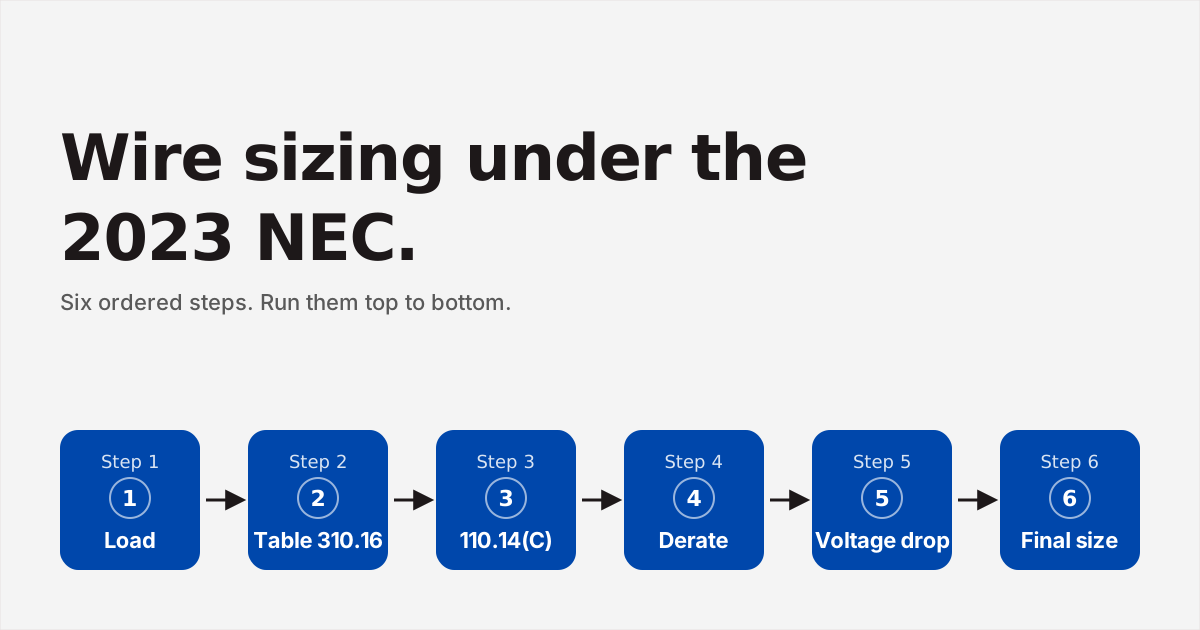
What does the 2023 NEC say about wire sizing?
Wire sizing under the NEC is picking a conductor whose ampacity (the current it can carry continuously without exceeding its temperature rating) meets or exceeds the calculated load, after every correction and adjustment factor, and is then matched to the temperature rating of the terminals it lands on. That's the working definition. It lives across Article 310 and Article 110 in the 2023 cycle.
The sections you pull off the shelf:
- NEC 310.14 (2023), general ampacity rules, conductor types, insulation ratings (THHN, THWN-2, XHHW, etc.).
- NEC 310.15 (2023), ampacity tables and adjustment/correction factors.
- NEC 310.16 (2023), the master ampacity table for conductors in raceway, cable, or earth.
- NEC 110.14(C) (2023), terminal temperature rating rule.
- NEC 240.4 (2023), overcurrent protection of conductors, including the small-conductor rule at 240.4(D).
- NEC 210.19(A)(1) and 215.2(A)(1) (2023), continuous-load 125% rule for branch circuits and feeders, voltage-drop guidance in the Informational Notes (3% branch, 5% total).
- NEC 310.12 (2023), the dwelling-service "83% rule" (covered in the aluminum H2 below).
Cycle deltas that matter: 2017 numbered the master table 310.15(B)(16); 2020 renumbered it to 310.16 and reorganized the correction factors out of 310.15(B)(2); 2023 kept the 2020 layout. If you're cross-checking a 2017 Mike Holt article against a 2023 codebook, the table number is the most common source of confusion. Same numbers in the cells, different label on the cover.
The 2023 NEC wire-sizing decision tree (six steps in order)
Here's the sequence. Run it top to bottom. The order matters more than any individual step, because applying derating before the terminal-column constraint (or the other way around) lands you on a different size than the code allows.
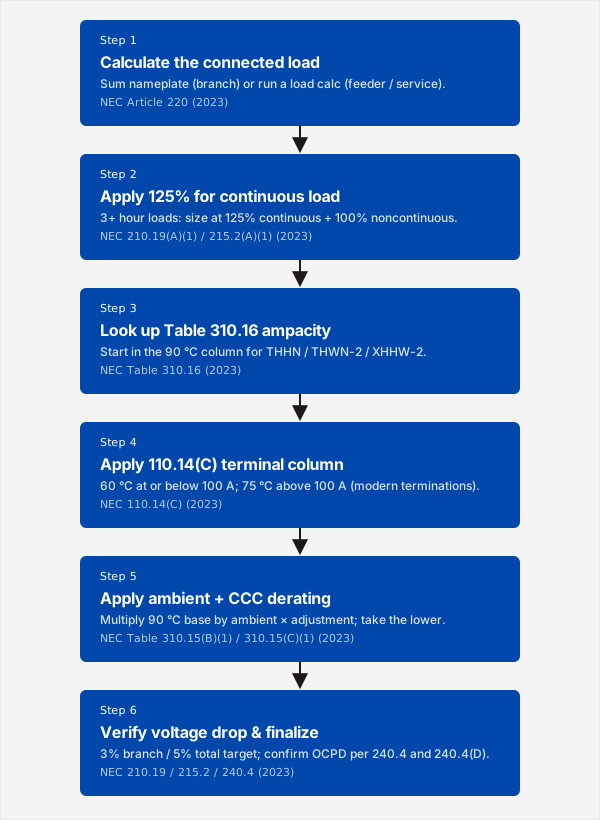
- Calculate the connected load. Branch circuit: sum of nameplate loads. Feeder or service: a load calc under NEC Article 220. If you haven't run the load calc, start at the load calculation walkthrough and the Breakerbox Load Calculator, then come back.
- Apply 125% for continuous load. Continuous = 3+ hours (NEC Article 100). EV chargers, commercial lighting, water heaters in some configs. NEC 210.19(A)(1)(a) (branch) and 215.2(A)(1)(a) (feeder) size conductor and OCPD at 125% of the continuous portion plus 100% of the noncontinuous portion. A 48 A continuous EVSE sizes the conductor at 60 A, not 48 A.
- Look up Table 310.16 minimum ampacity. Pick the row (AWG or kcmil) whose ampacity meets or exceeds step 2. Start in the 90 °C column for the conductor type you're pulling (THHN, THWN-2, XHHW-2 are all 90 °C). The 90 °C column is the starting point for derating, not the as-installed ampacity.
- Apply 110.14(C) terminal column constraint. NEC 110.14(C)(1) says conductor ampacity must be read from the column matching the lowest-rated termination in the path. Circuits at 100 A or less default to 60 °C unless the equipment is listed for 75 °C. Circuits over 100 A default to 75 °C. The 90 °C column is the column you derate from, not the as-installed number.
- Apply ambient + conduit-fill derating. NEC Table 310.15(B)(1) for ambient (a 90 °C conductor in a 110 °F attic × 0.91). NEC Table 310.15(C)(1) for >3 CCCs in a raceway (4–6 = 80%, 7–9 = 70%). Apply both to the 90 °C base, then compare to the 110.14(C) terminal-column ampacity. The lower is your usable number. For raceway rules tied to derating, see the Article 300 wiring methods guide.
- Verify voltage drop and finalize. Voltage drop is an Informational Note recommendation (3% branch, 5% total) under NEC 210.19 and 215.2, not enforceable code. If it forces an upsize, take it. Then verify the OCPD per NEC 240.4 (and 240.4(D): 15 A on 14 AWG Cu, 20 A on 12 AWG Cu, 30 A on 10 AWG Cu).
Self-contained answer: Which step comes first, derating or the terminal column? Neither. They're both ceilings applied to the 90 °C base ampacity, and you take the lower of the two. The terminal-column constraint isn't a derating; it's a separate ceiling that says no matter what the conductor can do thermally, the lugs limit it. A 4/0 Al at 75 °C is rated 180 A. The same conductor derated for four CCCs and a 110 °F ambient might still calc at 200+ A in the 90 °C column, but you can't use that number because the terminals cap you at 180 A.
How do I read NEC Table 310.16? (with the 2023 table inline)
NEC Table 310.16 is the master ampacity table for insulated conductors in raceway, cable, or earth. Three temperature columns per material (60, 75, 90 °C). Walk row first (conductor size), column second (lowest-rated termination per 110.14(C)). The intersection is the ampacity, before ambient or conduit-fill adjustment.
The table below reproduces 2023 NEC Table 310.16 for the sizes electricians pull on residential and small-commercial work. 75 °C is the column for most circuits over 100 A. 60 °C is the column for most circuits at or below 100 A unless the equipment is listed for 75 °C. 90 °C is the derating starting point only.
Table 310.16 (2023 NEC), copper
| Conductor (Cu) | 60 °C (TW, UF) | 75 °C (RHW, THW, THWN, XHHW) ← terminal column for >100 A | 90 °C (THHN, THWN-2, XHHW-2) ← derate from here |
|---|---|---|---|
| 14 AWG | 15 | 20 | 25 |
| 12 AWG | 20 | 25 | 30 |
| 10 AWG | 30 | 35 | 40 |
| 8 AWG | 40 | 50 | 55 |
| 6 AWG | 55 | 65 | 75 |
| 4 AWG | 70 | 85 | 95 |
| 3 AWG | 85 | 100 | 115 |
| 2 AWG | 95 | 115 | 130 |
| 1 AWG | 110 | 130 | 145 |
| 1/0 AWG | 125 | 150 | 170 |
| 2/0 AWG | 145 | 175 | 195 |
| 3/0 AWG | 165 | 200 | 230 |
| 4/0 AWG | 195 | 230 | 260 |
| 250 kcmil | 215 | 255 | 290 |
| 350 kcmil | 260 | 310 | 350 |
Note on the 14, 12, and 10 AWG copper rows: the ampacities shown above are the raw 310.16 values, but NEC 240.4(D) caps the OCPD at 15 A (14 AWG), 20 A (12 AWG), and 30 A (10 AWG) regardless of the temperature column. That's the small-conductor rule. Read the table number, then read the OCPD ceiling.
Table 310.16 (2023 NEC), aluminum and copper-clad aluminum
| Conductor (Al) | 60 °C (TW, UF) | 75 °C (RHW, THW, THWN, XHHW) ← terminal column for >100 A | 90 °C (THHN, THWN-2, XHHW-2) ← derate from here |
|---|---|---|---|
| 12 AWG | 15 | 20 | 25 |
| 10 AWG | 25 | 30 | 35 |
| 8 AWG | 30 | 40 | 45 |
| 6 AWG | 40 | 50 | 55 |
| 4 AWG | 55 | 65 | 75 |
| 3 AWG | 65 | 75 | 85 |
| 2 AWG | 75 | 90 | 100 |
| 1 AWG | 85 | 100 | 115 |
| 1/0 AWG | 100 | 120 | 135 |
| 2/0 AWG | 115 | 135 | 150 |
| 3/0 AWG | 130 | 155 | 175 |
| 4/0 AWG | 150 | 180 | 205 |
| 250 kcmil | 170 | 205 | 230 |
| 350 kcmil | 210 | 250 | 280 |
Aluminum starts at 12 AWG because NEC 240.4(D)(2) caps aluminum branch-circuit conductors at 12 AWG minimum (no 14 AWG aluminum branch circuits). Compared to copper at parity sizes, aluminum sits roughly one size below: 4/0 Al at 75 °C (180 A) is comparable to 2/0 Cu at 75 °C (175 A). That's the practical equivalence electricians use when bidding.
When is the 90 °C column the final ampacity?
Almost never. NEC 110.14(C)(1)(b) is the rare case where you can use the 90 °C column as the final number: when all terminals in the path are listed for 90 °C operation, which on residential and small-commercial gear is almost never. Practical rule: derate from 90 °C, compare to the 75 °C (or 60 °C) column, take the lower.
When do I have to derate, and in what order?
Two derating buckets apply to the 90 °C base ampacity. Both come from NEC Table 310.15 in the 2023 cycle.
Ambient correction (NEC Table 310.15(B)(1)): adjusts ampacity for ambient above or below 30 °C (86 °F). A 90 °C conductor in 105 °F (41–45 °C) ambient gets multiplied by 0.91. In a 115 °F attic (46–50 °C) it's 0.82.
Adjustment for >3 current-carrying conductors (NEC Table 310.15(C)(1)): more than 3 CCCs in the same raceway, cable, or bundle for more than 24 inches: 4–6 = 80%, 7–9 = 70%, 10–20 = 50%. The neutral on a 120/240V single-phase circuit is not a CCC under NEC 310.15(E) unless the load is over 50% nonlinear. On most residential work the neutral doesn't count.
Order: multiply the 90 °C base ampacity by ambient × adjustment. Apply both to the 90 °C number, then compare the result to the 110.14(C) terminal-column ampacity. The lower of the two is what you use. Do not apply derating to an already-terminal-constrained number, that double-counts the constraint.
Mini-example: 6 AWG Cu THHN, 50 A load, 4 CCCs, 110 °F ambient. 90 °C ampacity: 75 A. Ambient (0.91) × adjustment (0.80) = 0.728. Derated 90 °C: 75 × 0.728 = 54.6 A. 75 °C terminal-column: 65 A. Usable: min(54.6, 65) = 54.6 A. 54.6 > 50, so 6 AWG Cu is good.
For the raceway-fill rules that drive CCC counts, the Article 300 guide linked above is the companion reference.
How do I size aluminum wire? (and what is the 310.12 "83% rule"?)
Aluminum gets its own section because the SERP underserves it and because the 310.12 dwelling allowance catches even experienced electricians. Three things to know.
1. Aluminum ampacity sits roughly one size below copper at parity. Compare 75 °C columns: 4/0 Al = 180 A, 4/0 Cu = 230 A. To carry the same load you go up about one trade size. That's why 4/0 Al is the standard 200 A residential service conductor while the same service on copper would use 2/0 or 3/0.
2. Aluminum demands listed-aluminum terminals. NEC 110.14(A) requires terminals identified for the conductor material. Modern breakers and lugs are marked AL9CU, CU/AL, or AL. Equipment marked CU only cannot land aluminum. On new work, AL9CU lugs and breakers solve the termination problem cleanly.
3. Aluminum branch circuits are capped at 12 AWG minimum by NEC 240.4(D)(2). In practice nobody pulls 12 AWG Al on branches anymore. Aluminum's lane is feeders and services, where the conductor cross-section gets large enough that the cost gap matters.
NEC 310.12 dwelling "83% rule" callout (the short version): NEC 310.12 (2023) lets you size dwelling-service SE conductors (and the main feeder of a single dwelling) at 83% of the service rating instead of 100%, recognizing that residential demand is highly diverse. For a 200 A dwelling service, a conductor rated for 200 × 0.83 = 166 A is allowed. The 75 °C aluminum column shows 4/0 Al at 180 A, which clears 166 A comfortably. That's why 4/0 Al is the de facto 200 A residential service conductor across most of the US. The rule also covers 100 A (83 A min), 125 A (104 A min), 150 A (125 A min), and 400 A (332 A min) services. Important boundary: 310.12 applies to the main service or main feeder of a single dwelling unit. It does not apply to multifamily SE conductors, subpanel feeders downstream of the main, or commercial service. For the full walkthrough, see the dedicated 310.12 service-entrance article when it ships. The 2023 cycle kept 310.12 unchanged from 2020; 2017 placed the rule at 310.15(B)(7), which is why older guides cite the wrong number.
Two edge cases that come up on aluminum work and aren't worth deep-diving here: parallel aluminum service conductors (NEC 310.10(G)) and aluminum grounded conductor (neutral) sizing on residential services (NEC 250.24(C)). When those questions land on a job, look it up in NEC Chat, it's faster than thumbing through Article 250.
How do I check voltage drop? (callout, full math is elsewhere)
Voltage drop is the rare NEC topic that isn't code-mandatory. The 3% branch / 5% combined recommendation lives in Informational Note 4 to NEC 210.19(A) and the Informational Note to 215.2(A)(1) (2023). Informational Notes aren't enforceable, but plan reviewers read them as if they were, and the customer experience (lights dimming on AC startup, motors running hot) makes voltage drop a real design constraint.
The one-liner for single-phase: VD = (2 × K × I × L) / CM, where K is 12.9 (Cu) or 21.2 (Al), I is amps, L is one-way feet, CM is circular mils. Divide by source voltage and multiply by 100 for percentage.
Example where VD forces an upsize: a detached garage subpanel 150 ft from the main, 50 A load, 6 AWG Cu (26,240 CM). VD = (2 × 12.9 × 50 × 150) / 26,240 = 7.37 V on 240 V = 3.07%. Over the 3% recommendation. 4 AWG (41,740 CM) drops it to 1.93%. 6 AWG passes ampacity but fails VD; 4 AWG is the right pull.
For the full math, three-phase VD, and distance thresholds where VD takes over from ampacity, see the full voltage-drop calculation walkthrough.
Worked examples: 100 A subpanel, 200 A service with EV, 50 A range
Three runs of the decision tree. Real numbers, real conductor picks, the kind of jobs that make up most residential wire-sizing decisions.
Example 1: 100 A copper subpanel feeder, indoor pull, 75 °C terminations
Inputs: 100 A panel-fed subpanel, 60 ft pull in EMT, 3 CCCs, 86 °F ambient, modern panel with 75 °C-rated terminals.
- Load: 100 A. Not continuous, no 125%.
- 90 °C Cu column: 1 AWG = 145 A.
- 110.14(C): 100 A defaults to 60 °C unless terminations are listed for 75 °C. Modern panels are, so read the 75 °C column. 1 AWG Cu at 75 °C = 130 A.
- Derating: 3 CCCs, 86 °F → no adjustment. Derated 90 °C = 145 A.
- Usable: min(145, 130) = 130 A. Clears 100 A. Voltage drop on 60 ft at 100 A is under 1%.
Pull: 1 AWG Cu THHN/THWN-2 + 1 AWG neutral + 6 AWG Cu EGC (NEC Table 250.122 (2023) sizes the EGC for a 100 A OCPD).
Example 2: 200 A residential service with a 48 A EV charger add
Inputs: existing 200 A residential service, 4/0 Al SE conductors per NEC 310.12. Customer is adding a 48 A continuous EVSE branch off the main panel.
Service conductors are sized under NEC 310.12 (2023) (the 83% rule), 4/0 Al at 180 A clears 166 A. Done at the service-entrance level. The service-entrance ampacity walkthrough covers meter-main, SE conductor, and neutral sizing in depth.
For the new EV branch:
- Load: 48 A continuous → 48 × 1.25 = 60 A minimum (NEC 210.19(A)(1)(a) and 625.42 (2023)).
- 90 °C Cu column: 6 AWG = 75 A.
- 110.14(C): 75 °C breaker terminals. 6 AWG Cu at 75 °C = 65 A.
- Derating: 3 CCCs, 86 °F → no adjustment.
- Usable: min(75, 65) = 65 A. Clears 60 A. OCPD = 60 A two-pole.
Pull: 6 AWG Cu THHN + 10 AWG Cu EGC (NEC Table 250.122 (2023) → 10 AWG Cu for 60 A OCPD).
Run the load calc on the existing service before stamping. A 48 A charger adds 14,400 VA, which on a borderline service triggers either load management (NEC 750) or a service upgrade. The load-calc guide linked at Step 1 covers add-load math for existing dwellings. To size the equipment grounding conductor on a 200 A service, see the dedicated guide.
Example 3: 50 A range branch circuit, copper NM cable
Inputs: 50 A electric range, 30 ft pull in NM-B cable (Romex), 86 °F ambient.
- Load: 50 A nameplate (NEC 422.10 (2023), typical for 8–12 kW residential ranges). Not continuous.
- 90 °C Cu column: 6 AWG = 75 A. But per NEC 334.80 (2023), NM ampacity reads the 60 °C column even though the conductors are 90 °C insulated. That's the NM-specific catch.
- NM 60 °C ampacity: 6 AWG Cu = 55 A. This is the binding constraint.
- Derating: 3 CCCs, 86 °F → no adjustment.
- Usable: 55 A. Clears 50 A. Voltage drop on 30 ft is about 1.4%.
Pull: 6/3 NM-B with ground (two 6 AWG hots, one 6 AWG neutral, one 10 AWG bare EGC).
The NM 60 °C-column rule (NEC 334.80 (2023)) is the most common 50 A range trap. Reading 6 AWG NM as 75 °C (65 A) ships a circuit the AHJ rejects. Same conductor in conduit as THHN reads 65 A at 75 °C, which is the right number outside of NM.
What are the most common wire-sizing mistakes electricians make?
The errors I see from apprentices, and from journeymen still on the 2017 cycle, cluster around five misreadings:
- Reading the 90 °C column as the as-installed ampacity. Most common. THHN insulation is rated 90 °C, so the conductor's thermal capacity is 90 °C, but the breakers, lugs, and panel terminals almost never are. Read 75 °C (or 60 °C at or below 100 A on equipment not listed for 75 °C) per NEC 110.14(C) (2023).
- Forgetting 125% on continuous loads. EV chargers, commercial lighting, any load running 3+ hours. NEC 210.19(A)(1)(a) (2023) for branches, 215.2(A)(1)(a) (2023) for feeders. Sizing a 48 A EVSE conductor at 50 A instead of 60 A is the most common ampacity callout on modern AHJ rejection lists.
- Applying derating to a terminal-constrained ampacity instead of the 90 °C base. Derate from 90 °C, compare to the terminal-column number, take the lower. Don't apply derating to the 75 °C number, that double-counts the constraint.
- Missing the >3 CCC threshold on conduit fill. Three CCCs is the no-adjustment bracket. Push to 4 and you're at 80%. Multiwire branch circuits, shared neutrals, three-phase circuits with a nonlinear-load neutral all change the count.
- Sizing the conductor but skipping OCPD verification. NEC 240.4 (2023) caps the OCPD at the ampacity, and 240.4(D) caps small conductors below ampacity. Check the next-standard-OCPD rule at 240.4(B) before stamping.
A field anecdote: a 60 A subpanel feeder I inspected had 6 AWG Cu THHN labeled "rated 75 A at 90 °C." Technically true. The 75 °C ampacity is 65 A. Panel terminals were 75 °C rated, so usable was 65 A, clears 60 A, fine. But it was failing inspection because the 60 A breaker was a 60 °C-only listed device, which dropped the terminal column to 60 °C and put 6 AWG at 55 A. New breaker, problem solved. The 90 °C column trap, the 110.14(C) constraint, and an obscure equipment listing, all in one rejection.
Edge cases pile up fast. Parallel conductors over 1/0, neutral-as-CCC on nonlinear loads, conductor-derate vs. busbar-derate on solar interconnects. When you hit one in the field, ask NEC Chat, it'll pull the right citation and the cycle-specific cell value in seconds.
Frequently asked questions
What size wire do I need for 100 amps? For a 100 A copper feeder with modern 75 °C-rated terminations, 1 AWG Cu THHN/THWN-2 is the standard pull (130 A at 75 °C per NEC Table 310.16, 2023). On aluminum, 2/0 Al at 75 °C is 135 A. If terminations are 60 °C only, you need 1/0 Cu (125 A at 60 °C). The OCPD is a 100 A breaker per NEC 240.4.
What size wire is needed for 200 amp service? For a 200 A dwelling service, NEC 310.12 (2023) lets you size SE conductors at 83% of the service rating: 200 × 0.83 = 166 A. 4/0 Al at 75 °C (180 A) is the standard pull, accepted nationwide. Copper SE conductors at 200 A typically use 2/0 Cu THWN-2 (175 A at 75 °C) or 3/0 Cu (200 A) depending on AHJ. See the service-entrance walkthrough.
What size wire for 50 amps? For a 50 A branch circuit in conduit with 75 °C-rated terminations, 6 AWG Cu THHN/THWN-2 (65 A at 75 °C). For a 50 A range circuit in NM cable, 6/3 NM-B is the standard, but NM ampacity per NEC 334.80 reads the 60 °C column (55 A at 6 AWG Cu), which still clears 50 A. The OCPD is a 50 A two-pole.
Can I use the 90 °C column for ampacity? Almost never as the final ampacity. NEC 110.14(C) requires you to read the temperature column matching the lowest-rated termination in the circuit, which on modern residential and small-commercial equipment is 75 °C, and on older equipment or small circuits is 60 °C. The 90 °C column is the starting point for ambient and conduit-fill derating, not the as-installed number you size from.
What is the 125% rule in the NEC? NEC 210.19(A)(1)(a) and 215.2(A)(1)(a) (2023) require branch circuits and feeders to be sized at 125% of any continuous load plus 100% of any noncontinuous load. A continuous load is defined in Article 100 as one operating 3 hours or longer. EV chargers, commercial lighting, and electric water heaters in some configurations are the common residential triggers.
When can I use aluminum wire for a service? Aluminum is allowed on services and feeders of any size as long as the terminations are listed for aluminum (AL9CU, CU/AL, or AL marking on the lugs). For dwelling services, NEC 310.12 (2023) permits 4/0 Al on a 200 A service, 1/0 Al on a 100 A service, and so on, sized at 83% of the service rating. Aluminum is not allowed on branch circuits below 12 AWG and is rare on residential branches generally.
What to do next
You have the six-step decision tree, the table inline, the aluminum path, and three worked examples. Now run yours. Pick the circuit, pull the load number from the load calc, walk the decision tree top to bottom, and don't skip the 110.14(C) check. If you find yourself stuck on an edge case (parallel conductors, MWBCs with nonlinear neutrals, parallel feeders sharing a conduit, the 310.12 boundary with subpanels), NEC Chat answers the lookup in seconds, it'll cite the 2023 NEC section directly and surface the cycle deltas from 2017 and 2020 if they matter to your AHJ.
If you hit voltage-drop edge cases or need the service-entrance breakdown, see those guides when they ship.