
If you searched "electrical load calculator" looking for a working tool, not 1,500 words of throat-clearing first, scroll past the next two blockquotes and you are there. The calculator runs the NEC 220.82 (2023) Optional Method and the 220.83 (2023) add-load mode on the inputs you type in. It returns demand VA, service amps, and a recommended service size.
TL;DR: The Breakerbox Load Calculator is a free, in-browser tool that runs NEC 220.82 (Optional Method) and 220.83 (existing-dwelling add load) on residential inputs you type in. It returns demand VA, service amps, and a recommended service size in the 100, 125, 150, 200, or 320-class. The tool is built and maintained by Jack Simpson, an electrical engineer with stamping experience on the 2017, 2020, and 2023 NEC cycles. No login, no paywall, no lead-gate.
A quick disclosure: The 2023 NEC is the primary cycle here. Where the 2017 or 2020 cycle differs on a rule the calculator uses, the delta is noted inline. Plenty of AHJs are still on 2020, so confirm the adopted cycle in your jurisdiction before you submit. I'm Jack Simpson, co-founder at Breakerbox and a licensed electrical engineer. I've stamped load calcs under the 2017, 2020, and 2023 cycles. We make the calculator on this page.
Run your numbers in the Breakerbox Load Calculator. Both Standard and Optional methods on the same inputs in one screen.
What does this electrical load calculator do?
An electrical load calculator is a tool that totals every connected and demand load in a dwelling, applies NEC Article 220 demand factors, and converts the result to amps so you can size the service. The Breakerbox version implements NEC 220.82 (Optional Method) and NEC 220.83 (existing-dwelling add load), both 2023-cycle, with 2017 and 2020 deltas in the field tooltips.
Inputs:
- Finished square footage (drives 3 VA/sq ft general lighting per NEC 220.12, 2023)
- Small-appliance and laundry circuit count (1,500 VA each per NEC 220.52, 2023)
- Fixed-appliance nameplates: range, dryer, water heater, dishwasher, disposal, microwave, well pump, pool pump
- HVAC: heat type, AC compressor running load, strip-heat kW
- Electrification add-ons: Level 2 EV charger amperage, PV system size
Outputs: total connected VA, demand VA after the 220.82 tiered factor (100% of first 10,000, 40% of remainder), service amps at 120/240V single-phase, and a recommended service size rounded to the next standard rating (100, 125, 150, 200, or 320-class). Also a printable summary showing each NEC section cited and the demand factor applied per line.
That last output is what matters at plan review. More on that in the AHJ section.
Calculator vs manual NEC 220 calc: which one do you need?
Most residential electricians I work with reach for a calculator on every single-family job, then drop into a hand calc only when the math gets weird. That instinct is correct, but it's worth knowing where the line is.
| Dimension | This calculator | Manual NEC 220 calc by hand |
|---|---|---|
| Time on a typical house | Under 60 seconds | 20 to 40 minutes |
| Methods supported | Optional 220.82, add-load 220.83 | Standard (Parts II–IV) and Optional, your choice |
| Accuracy on Optional Method | Matches hand calc to rounding | Same, by definition |
| AHJ-ready output | PDF with NEC sections cited and demand factors visible | Whatever your worksheet looks like |
| Best fit | New single-family build, service upgrade, retrofit, EV or heat-pump add | Heavy electric-resistance heat, commercial-grade range, multi-zone HVAC |
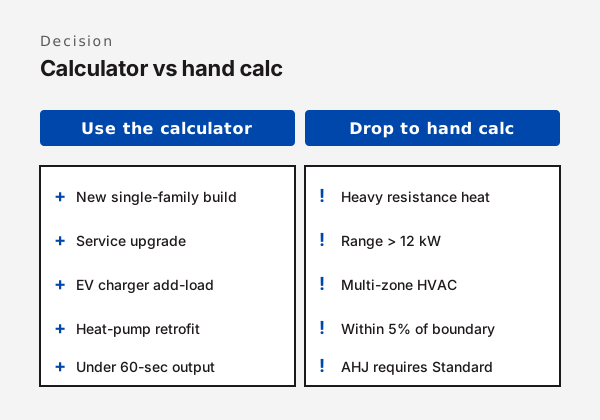
The bottom line: for 90% of single-family dwellings, the calculator is the right tool. The hand calc is your fallback when the house is loaded with continuous-duty equipment that pushes the Optional Method out of its sweet spot. If you want the manual method laid out end to end on a real 2,000 sq ft house, the full NEC 220 method walkthrough runs both Standard and Optional side by side on the same inputs.
One thing the calculator cannot do for you: decide whether to push from 200A to a 320-class meter when the math lands close to a service-size boundary. That's a customer-plan question, not an NEC question, and it lives at the end of this guide.
Will my AHJ accept a load calculator printout?
Yes, almost always, provided the printout shows the NEC sections cited and the demand factor applied to each line. AHJs reject totals-only outputs (just a number that says "182 amps"). They accept any worksheet that shows line items traceable back to NEC Article 220. The Breakerbox PDF export shows both.
When I submit a calc to plan review, the inspector checks for four things:
- NEC cycle year on the worksheet. Whichever cycle your AHJ has adopted (2017, 2020, or 2023), the calc needs to say it.
- Method declared explicitly. Standard Method (220 Parts II–IV) or Optional Method (220.82). Don't make the reviewer guess.
- Demand factors visible per line. Each line in the "other loads" bucket should show raw VA, demand factor applied, and resulting demand VA. The Optional Method's 100%-then-40% tier needs to show the breakpoint.
- HVAC handling shown. Larger of heat or AC under NEC 220.60 (2023), with the smaller one noted as omitted. On heat pumps with strip backup, the worst-case strip-heat condition should be on the page.
A handful of municipal AHJs require their own worksheet form. Copy the line totals over; the math is the same.
How accurate is this calculator vs a hand calc?
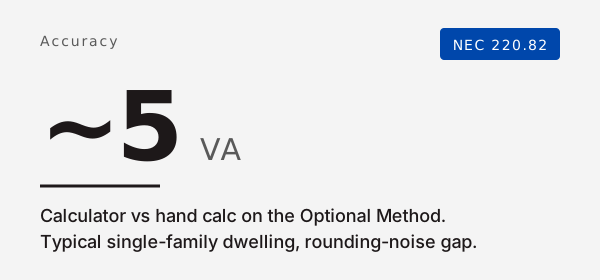
Under the Optional Method (NEC 220.82, 2023), the Breakerbox calculator matches a hand calc to rounding. Within about 5 VA on a typical single-family dwelling, which is the rounding noise on the input nameplates, not error in the tool. That's because the Optional Method is one tiered demand factor on a sum of nameplates: there is nowhere for a divergence to hide.
The Standard Method is where things get interesting, and where the calculator's Optional-only output can land away from what a hand-run Standard Method would produce on the same house. On most single-family houses with average appliance loads, the two methods land within 5–10% of each other; divergence over that range usually points at one outsized appliance load (range, dryer, heat pump) the Optional Method's flat factor is absorbing differently than the Standard Method's per-load tables.
Three specific conditions where the gap widens:
- Heavy electric resistance heat. 220.42's lighting demand factor combined with 220.53's 75% fixed-appliance factor compounds differently than 220.82's flat 40% tier when the heating load is dominant.
- Commercial-grade range above 12 kW. NEC 220.55 Table Note 4 (2023) ratchets the demand up for ranges over 12 kW in a way the Optional Method's nameplate-direct treatment does not.
- Multi-zone HVAC. Two or more independent compressors trigger the non-coincident logic at NEC 220.60. Optional Method takes the larger of total heat or total AC; Standard Method can carve those decisions finer.
On a 200A borderline calc I ran last fall, the Optional Method landed at 197.8 A. The Standard Method on the same house ran about 11% higher. The customer was 12 months out from a 48A EV charger install, and we pushed to a 320-class meter on that basis. Without the Standard cross-check, we'd have stuck at 200A and triggered a service upgrade inside the warranty window.
The honest rule: run Optional first in the calculator. If you land within 5% of a service-size boundary, re-run by hand under Standard. How to run the calc by hand walks through both methods on the same 2,000 sq ft house.
After the calculator: what comes next?
You have a demand VA total and a service-amp number. Two things happen next.
First, round to the next standard service rating: 100, 125, 150, 200, 225, 320-class, or 400. Under 30,000 VA demand runs on 125A. Between 30,000 and 48,000 lands on 200A. Above 48,000 VA, you're looking at a 320-class meter base. Most new single-family construction in 2026 is 200A as a working floor, regardless of what the calc says, because of electrification planning.
Once you have a demand-amp total, the next step is sizing the service-entrance conductors, the grounding electrode conductor, the neutral, and any feeders to subpanels. The calculator stops at the amp number; the conductor sizing is its own table-lookup exercise under NEC 310.16 (2023) and 310.12 (2023) (the dwelling 83% rule). A sizing walkthrough on that side ships shortly after this guide.
The rounding decision deserves a beat of thought. If the calc lands at 195 A on a 200A service and the customer has electrification plans in the next 24 months (EV, heat pump, induction range), pushing to a 320-class meter base now is usually cheaper than a second mobilization later. The calculator won't make that call. Reading the customer's plans is the part you do.
If you want a sense of what the conductor side looks like, the wire-sizing decision tree covers Table 310.16, the 110.14(C) terminal-column rule, and the 83% dwelling-service rule.
What if I'm adding an EV charger, heat pump, or solar?
This is where the calculator earns the time it saves. Electrification changes the calc in ways a 1990s rule of thumb misses, and the three add-ons each bend the math differently.
EV charger. A 48A continuous Level 2 charger sizes at 48 × 240 × 1.25 = 14,400 VA on the load calc (NEC 625.42 for the continuous rule, NEC 215.3 for the 125% multiplier, both 2023). The calculator runs this as a 220.83 add-load on top of the existing dwelling baseline. On a 200A service that was already at 175 A before the charger, the add usually pushes the calc over and surfaces the service-upgrade trigger. The alternative is an energy management system per NEC 750.30 (2023), which lets you keep the 200A by limiting concurrent loads.
Heat pump with strip-heat backup. The worst case is the strip-heat-only condition at lockout temperature, not the compressor running normally. NEC 220.51 (2023) wants you to use the larger of (compressor + air handler) or (strip heat + air handler). On most 3-ton heat pumps with a 10 kW backup, the strip-heat case is the larger number. The calculator surfaces both and uses the larger, which is the same answer your AHJ would get by hand.
Solar. PV does not reduce the load calc. The service still has to be sized for the worst-case load with the sun down and the batteries empty. What PV affects is the busbar calculation under NEC 705.12 (2023), the 120% rule for load-side interconnections. Load calc and PV interconnect calc are two separate calculations on the same permit packet. The calculator's output is the load calc number; the busbar math is its own exercise.
The pattern across all three: the calculator catches the service-upgrade trigger early enough to plan the upgrade, instead of finding out at rough inspection that the original service can't carry the new load.
Frequently asked questions
How do I use an electrical load calculator?
- Open the Breakerbox Load Calculator in a new tab.
- Enter your finished square footage and the count of small-appliance plus laundry circuits.
- Enter nameplate VA or watts for every fixed appliance: range, dryer, water heater, dishwasher, disposal, microwave, well pump, pool pump.
- Enter HVAC inputs (heat type, AC compressor VA, strip-heat kW if heat pump). The tool picks the larger of heat or AC per NEC 220.60 (2023).
- Read the demand VA, service amps, and recommended service size at the bottom. Click Export PDF for the AHJ-ready printout.
What is the formula for electrical load calculation?
Demand VA divided by service voltage equals service amps. For a 120/240V single-phase residence, amps equal demand VA divided by 240. Demand VA itself is the sum of every load category after NEC Article 220 demand factors are applied. Under the Optional Method (NEC 220.82, 2023), the demand factor is a single tiered figure: 100% of the first 10,000 VA of "other loads," 40% of the remainder, with HVAC added at 100%.
Do I need a load calculator to add an EV charger?
Yes. NEC 625.42 (2023) treats EV supply equipment as a continuous load, which means the conductor and OCPD have to be sized at 125% of the EV charger's amp rating. NEC 220.83 (2023) requires a load calc for any add-load on an existing dwelling. A 48A charger on an existing 200A service that's already drawing 175A under the existing calc pushes the dwelling over 200A and triggers either a service upgrade or an energy management system per NEC 750.30 (2023). The calculator runs both numbers (before and after) so the decision is clear before the conductor is in the ground.
Is this calculator free to use?
Yes. No login, no paywall, no lead-gate, no usage cap. The PDF export is free too. Run your numbers and export the PDF.
Run your numbers
Open the calculator. Drop in your square footage and nameplates, and the calculator produces your demand VA, service amps, and recommended service size in under a minute. Export the PDF if you want the AHJ-ready printout. The calculator is NEC-accurate (2023 primary, 2017/2020 deltas in the field tooltips), engineer-built, and free.