
If you searched "EV charger load calculation" because a customer wants a 48 A Level 2 charger on an existing 200 A service and you need to know whether the panel survives, you are in the right place. Most guides on this query show one NEC method (usually 220.82) and skip the path the AHJ wants on most retrofits. This one runs both, line-by-line, on the same house.
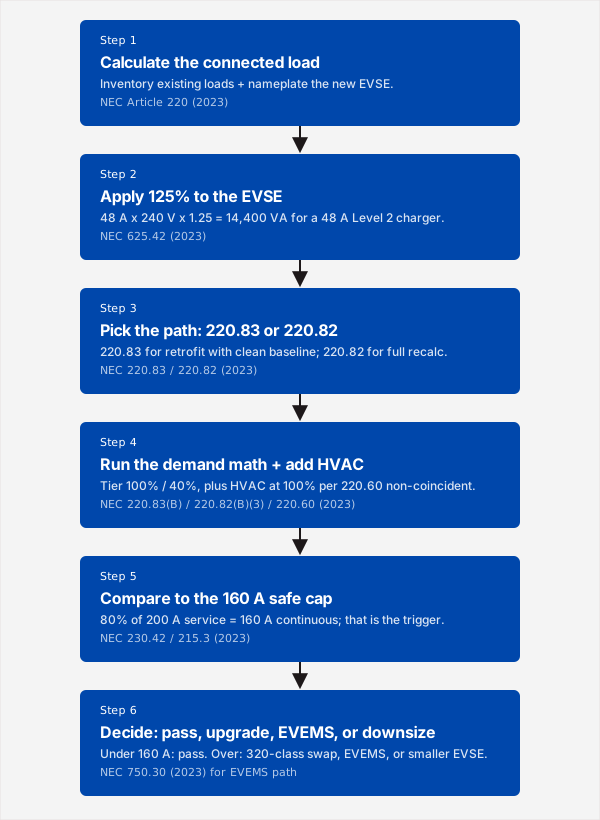
TL;DR: A 48 A continuous Level 2 EVSE is 14,400 VA on the service calc (48 A × 240 V × 1.25, per NEC 625.42, 2023). On an existing dwelling you can run NEC 220.83 (existing-dwelling add-load) or NEC 220.82 (Optional Method, full recalc). 220.83 is the fast retrofit path. 220.82 is the conservative path when the existing-load inventory is shaky. Both get walked here against the same 2,200 sq ft house, same 200 A service, same loads, with the panel-upgrade trigger marked at 160 A safe capacity.
A quick disclosure: This guide is anchored to the 2023 NEC. Where the 2017 or 2020 cycle differs on a rule that matters here, the delta is noted inline. The 2026 cycle changes the math on EVSE (EV at 100%, EVEMS expansion, 8,000 VA first tier). Those are flagged as forward-look, not current rule. Confirm the adopted code in your jurisdiction before you stamp. I'm Jack Simpson, co-founder at Breakerbox and a licensed electrical engineer. I've stamped EVSE load calcs on existing dwellings under all three recent cycles. We make the Breakerbox Load Calculator.
Is a load calculation required for an EV charger install?
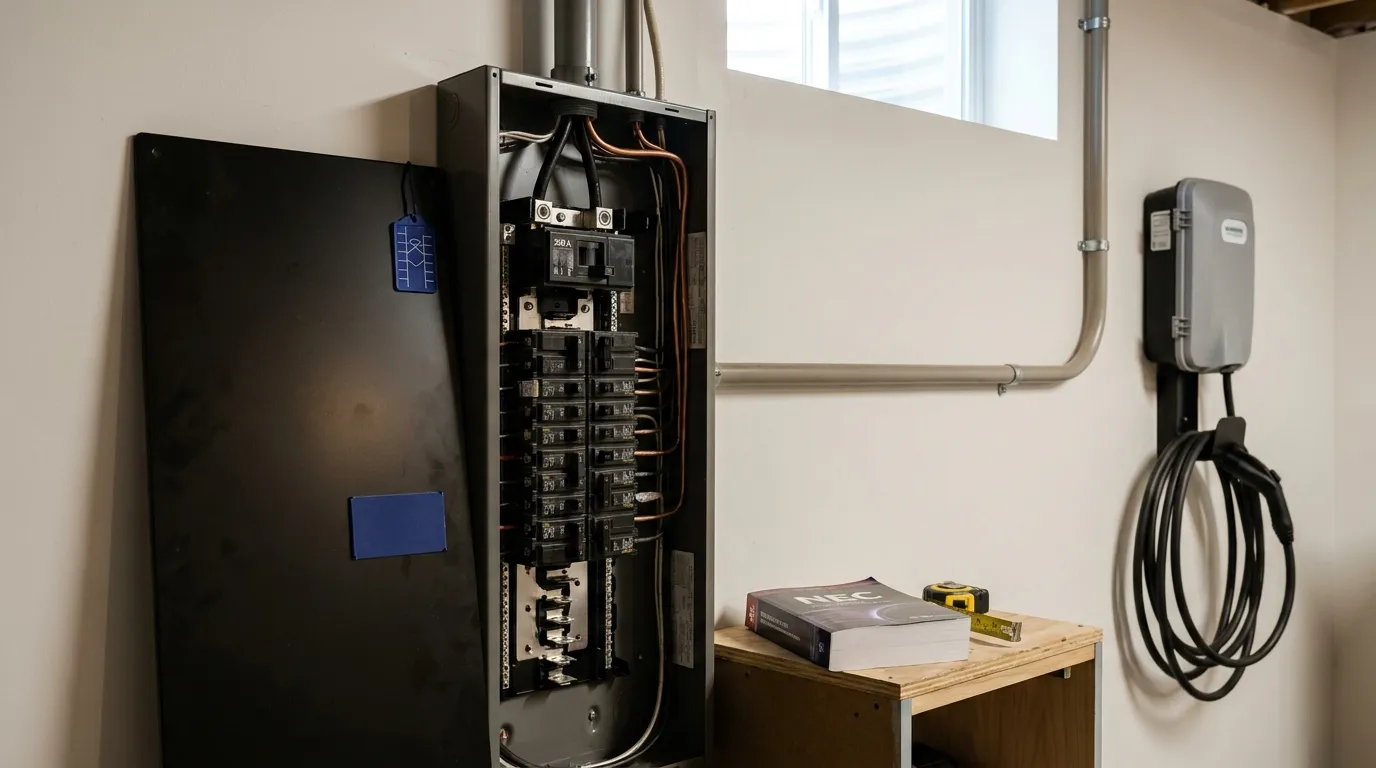
Yes. Any 40 A or larger EVSE added to an existing dwelling triggers a load calc under NEC 220 and NEC 625.40 (2023). A load calculation determines whether the existing service has capacity to absorb the new EVSE without exceeding the safe continuous rating of the service-entrance equipment.
The trigger list, in practice:
- Any Level 2 EV charger 40 A and above on an existing service
- Any service upgrade where the EVSE is part of the new load
- New construction with EVSE-ready provisions
- Any change that increases the calculated load on a service already near 80% of its rating
Most AHJs want the calc on the permit application. Some accept a one-page worksheet. Some require a stamped calc from a licensed pro. A handful publish their own form and want the line items copied across. The math is the same either way.
Cycle deltas worth knowing. The 7,200 VA EVSE minimum at NEC 220.57 landed in the 2023 cycle. On 2017 and 2020 jobs that floor was convention rather than code. The 2026 cycle moves further: EVSE counted at 100% with no demand factor, first demand-factor tier moves to 8,000 VA, and EVEMS is formally expanded as an alternative to a service swap. Today, working under 2023, the 7,200 VA floor and the demand factor both apply. Bring up the 2026 cycle if you are scoping a job that will permit after your AHJ adopts it.
What are the two NEC paths for an existing dwelling?
For a Level 2 charger on a house that is already lived in, the NEC gives you two clean Optional Method routes plus the Standard Method as a fallback.
- NEC 220.82, the Optional Method, full recalculation. You inventory every existing load plus the EVSE, apply the 220.82 demand factor, and end up with one total. Used on new construction, used on full service recalcs, accepted on retrofits when the AHJ wants the whole picture.
- NEC 220.83, the Optional Method for adding loads to an existing dwelling. You compute only the added load on top of a defined existing-load baseline, apply the 220.83 demand factor to the combined other-loads stack, and end up with a smaller total. This is the path the AHJ most often wants on a retrofit because it isolates the change.
- NEC 220 Part III (Standard), the full per-line demand tables. This is the fallback when the dwelling does not qualify for Optional (rare on single-family) or when the AHJ specifically wants Standard. Most retrofit EVSE jobs do not need it.
| Method | When you use it | Demand factor on other loads | Cycle anchor |
|---|---|---|---|
| NEC 220.82 (Optional, full) | New build, full recalc, retrofit when existing-load inventory is needed | 100% of first 10,000 VA, 40% of remainder | 2023 (2017/2020 essentially the same) |
| NEC 220.83 (Existing dwelling add-load) | Adding a load to an existing service, EVSE retrofit, panel upgrade with carried-over loads | 100% of first 8,000 VA of combined other loads, 40% of remainder | 2023 (8,000 VA first tier); 2026 forward-look moves the tier |
| NEC 220 Part III (Standard) | Optional Method ineligible, or AHJ requires it | Per-load tables (220.42, 220.53, 220.54, 220.55) | 2023 |
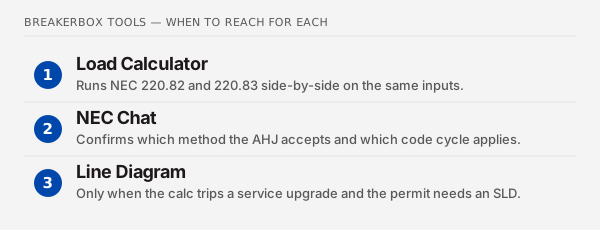
Which one to pick on an EV retrofit. Default to 220.83 if the existing dwelling has been lived in long enough that you can trust the existing-load baseline (single owner, no recent additions, panel directory accurate). Default to 220.82 if you cannot verify what is actually on the panel, because 220.82 makes you inventory every nameplate and surfaces the hidden loads. If the AHJ has a published preference, follow it. You can run this in the Breakerbox Load Calculator under either method and compare totals before you commit.
Not sure which one your jurisdiction accepts on a retrofit? Ask NEC Chat which method your AHJ accepts. It tracks the AHJ acceptance patterns by jurisdiction so you do not have to call the inspector before you bid.
For the broader residential method on a non-EV job, the full residential load calculation walkthrough runs Standard and Optional side-by-side on a different house.
Worked example: 48 A EVSE on a 200 A service, both NEC paths
This is the section the rest of the SERP skips on. We lock the scenario once, then run both methods. Same house, same loads, same EVSE. Two demand-factor applications, two final amp totals.
Scenario inputs (used for both paths):
- 2,200 sq ft existing single-family dwelling
- 200 A, 120/240 V single-phase service
- Existing loads:
- Electric range: 10 kW (10,000 VA) nameplate, single unit
- Electric dryer: 5 kW (5,000 VA) nameplate
- Electric water heater: 4.5 kW (4,500 VA) nameplate
- HVAC: 5-ton heat pump, compressor running load 6,000 VA, 10 kW (10,000 VA) strip heat lockout backup
- Dishwasher: 1,200 VA
- Disposal: 1,000 VA
- 2 small-appliance branch circuits (kitchen): 1,500 VA each
- 1 laundry branch circuit: 1,500 VA
- New EVSE: 48 A continuous Level 2 charger, 240 V
Shared EVSE math. A 48 A continuous load at 240 V, treated at 125% per NEC 625.42 (2023) and 210.19(A)(1)(a) / 215.2(A)(1)(a) (2023), lands at:
48 A × 240 V × 1.25 = 14,400 VA on the service load calc.
The 7,200 VA minimum at 220.57 (2023) does not bind here because nameplate × 1.25 is already well above the floor. The 2026 cycle treats EVSE at 100% with no demand factor in the service calc, which would change this number; today, working under 2023, 14,400 VA is the input that goes into both paths below.
HVAC math (shared). NEC 220.60 (2023) lets you take the larger of two non-coincident loads. Compressor at 6,000 VA versus strip-heat lockout at 10,000 VA. Take 10,000 VA. The compressor and the strip heat will not run simultaneously at lockout, so the strip-heat number is the worst case.
Path A: NEC 220.83 (existing-dwelling add-load)
I run 220.83 most often on EV retrofits because the AHJs I work with usually accept it when the panel directory is current and the existing-load history is clean. The 2,200 sq ft Craftsman I bid last month with this exact 48 A profile took the 220.83 stamp on the first review.
220.83 is the retrofit path. It computes a single total against an existing-load baseline plus the added load, applies the 220.83 demand factor (100% of first 8,000 VA, 40% of remainder) to the combined other-loads stack, and adds HVAC at 100%.
| Line | NEC ref | Raw VA |
|---|---|---|
| General lighting (2,200 sq ft × 3 VA) | 220.12 (2023) | 6,600 |
| Small-appliance circuits (2 × 1,500) | 220.52(A) | 3,000 |
| Laundry circuit (1 × 1,500) | 220.52(B) | 1,500 |
| Range (nameplate) | 220.83 | 10,000 |
| Dryer (nameplate, min 5,000) | 220.83 | 5,000 |
| Water heater | 220.83 | 4,500 |
| Dishwasher | 220.83 | 1,200 |
| Disposal | 220.83 | 1,000 |
| EVSE (48 A × 240 V × 1.25) | 625.42 / 220.83 | 14,400 |
| Other-loads subtotal | 47,200 |
Apply 220.83 demand factor (2023): first 8,000 VA at 100%, remainder at 40%.
- First 8,000 × 100% = 8,000
- Remainder 39,200 × 40% = 15,680
- Other-loads demand = 23,680 VA
Add HVAC at 100% per 220.83 (larger of heat or AC, NEC 220.60):
- HVAC demand = 10,000 VA (strip-heat lockout)
220.83 total demand = 23,680 + 10,000 = 33,680 VA
Convert: 33,680 VA ÷ 240 V = 140.3 A.
Compare to 80% of 200 A safe continuous capacity = 160 A.
140.3 A is comfortably under 160 A. This service passes 220.83 with the 48 A EVSE added. The panel does not need an upgrade for this load profile.
Path B: NEC 220.82 (Optional Method, full recalc)
220.82 throws every load into one bucket (lighting, small-appliance, laundry, fixed appliances, EVSE), applies the 220.82 demand factor (100% of first 10,000 VA, 40% of remainder), then adds HVAC at 100% per 220.82(C).
| Line | NEC ref | Raw VA |
|---|---|---|
| General lighting (2,200 sq ft × 3 VA) | 220.12 (2023) | 6,600 |
| Small-appliance circuits (2 × 1,500) | 220.52(A) | 3,000 |
| Laundry circuit (1 × 1,500) | 220.52(B) | 1,500 |
| Range (nameplate) | 220.82(B)(2) | 10,000 |
| Dryer (nameplate, min 5,000) | 220.82(B)(2) | 5,000 |
| Water heater | 220.82(B)(2) | 4,500 |
| Dishwasher | 220.82(B)(2) | 1,200 |
| Disposal | 220.82(B)(2) | 1,000 |
| EVSE (48 A × 240 V × 1.25) | 625.42 / 220.82(B)(2) | 14,400 |
| Other-loads subtotal | 47,200 |
Apply 220.82(B)(3) demand factor (2023): first 10,000 VA at 100%, remainder at 40%.
- First 10,000 × 100% = 10,000
- Remainder 37,200 × 40% = 14,880
- Other-loads demand = 24,880 VA
Add HVAC at 100% per 220.82(C):
- HVAC demand = 10,000 VA (strip-heat lockout)
220.82 total demand = 24,880 + 10,000 = 34,880 VA
Convert: 34,880 ÷ 240 = 145.3 A.
Compare to 80% of 200 A safe continuous capacity = 160 A.
145.3 A is under 160 A. This service passes 220.82 with the 48 A EVSE added. Same answer as 220.83, with a slightly higher demand number.
Side-by-side
| Method | Demand VA | Service amps | Vs 160 A safe cap | Result |
|---|---|---|---|---|
| NEC 220.83 (existing-dwelling add-load) | 33,680 | 140.3 A | 19.7 A headroom | Pass |
| NEC 220.82 (Optional Method, full) | 34,880 | 145.3 A | 14.7 A headroom | Pass |
Same house, same EVSE, two NEC paths, ~1,200 VA spread between them. About 5 A at the service. 220.82 lands higher because the 100%-then-40% tier turns over at 10,000 VA instead of 8,000 VA, so a smaller slice of the bucket gets the 40% treatment. On a borderline calc that spread is the difference between a pass and a panel upgrade conversation. Both pass here, but if any of those nameplate numbers grew, 220.82 would trip the 160 A threshold first.
Want to run your own numbers without rebuilding the line items by hand? The Breakerbox Load Calculator runs both methods side-by-side for free, on the inputs you type in, with an AHJ-ready PDF export.
When the math trips a panel upgrade
The 160 A threshold on a 200 A service is the line where the math forces a decision. 80% of 200 A is 160 A, the conservative safe continuous capacity for service-rated equipment under the standard reading of NEC 230.42 and 215.3 (2023). Land at or above 160 A and you are looking at three real options. I had a customer last spring whose 220.82 calc landed at 165 A on a 200 A service with a 48 A charger. EVEMS under NEC 750.30 closed a four-month service-upgrade wait, and the AHJ took the load-management approach without a panel swap.
Panel-upgrade trigger callout
If your demand calc lands above 160 A on a 200 A service, you have hit the upgrade trigger. Three paths from there:
- Service upgrade to 320-class. Bigger meter base, bigger panel, room for future electrification. Permit + POCO coordination + cost.
- Load management via EVEMS per NEC 750.30 (2023). An energy management system limits concurrent loads so the EVSE backs off when the rest of the house is drawing. Keeps the 200 A service. The 2026 cycle expands EVEMS recognition further; flag for any 2026+ permit.
- Downsize the charger. 40 A or 32 A instead of 48 A. Less elegant, but if the customer can live with slower charging it avoids the upgrade.
Why 160 A specifically. Service-rated equipment carries a continuous-load limit that lands at 80% of the breaker / service rating under the conservative reading of 230.42 (service conductor sizing for continuous loads) and 215.3 (feeder continuous-load sizing). The math is the same whether you frame it as "size the equipment at 125% of continuous" or "limit continuous to 80% of equipment rating." Both are expressions of the same NEC 100 continuous-load rule.
2026 NEC forward-look. The 2026 cycle treats EVSE at 100% in the service calc with no demand factor reduction. On the scenario above, that change pushes the 220.83 number from 140.3 A toward roughly 150 A and the 220.82 number from 145.3 A toward roughly 155 A. Both still under 160 A on this house, but on a slightly heavier dwelling that change is the difference between a clean pass and a forced upgrade. The 2026 cycle also expands EVEMS recognition, which makes path 2 above more accessible. Today, working under 2023, the existing demand factors still apply.
The decision side of this (service-swap cost, permit timeline, EVEMS vs swap trade-offs, when downsizing the charger makes financial sense) sits in a separate guide. The load math here is what produces the number you take into that decision.
If the calc forces an upgrade and you are pulling the permit, most AHJs want a single-line diagram on the packet. The Breakerbox Line Diagram tool generates the SLD from the panel inventory you already typed into the load calculator. That tool only matters on the upgrade-triggered branch.
After the load: wire, breaker, and the rest of NEC 625
Two pieces of the EVSE install sit outside the load calc and deserve a quick scope-handoff so you do not duplicate work.
Wire and breaker for a 48 A continuous EVSE. Conductor sized at 60 A minimum ampacity (48 × 1.25, 75 °C terminal column), OCPD at 60 A per NEC 210.19(A)(1)(a) and 625.42 (2023). On a 200 A residential service the typical install is 6 AWG copper THHN/THWN-2 in conduit at 75 °C terminations. Derating, voltage drop, conduit fill all live in the wire-sizing decision tree, not here. For the full walkthrough on this exact scenario, see the 48 A EVSE wire-sizing walkthrough (Example 2 in that guide covers the 200 A service with an EV add).
Broader NEC 625 requirements. GFCI per 625.54, disconnect per 625.43, ventilation, signage, listing requirements. Those are NEC 625 article-level rules outside the load calc. The only NEC 625 section that lives in this article is 625.42 (continuous-load rating, EVEMS provisions), because it is structurally part of the load math. Full article-level reference on 625 ships separately.
AHJ edge cases and the 2026 NEC forward-look
Three real-world edge cases come up on EVSE retrofits often enough to call out.
Which method does the AHJ want. Most jurisdictions accept either 220.82 or 220.83 on a retrofit. A handful require 220.82 when the existing-load inventory cannot be verified from the panel directory. A few accept a manufacturer worksheet in lieu of either. If you bid in a jurisdiction you have not worked before, the cheapest insurance is a call to the building department before you stamp.
Cycle currency. Most AHJs in 2026 are on the 2023 cycle, a meaningful slice are still on 2020, and a few have already adopted 2026. The deltas that matter on EVSE:
- 2017/2020 → 2023: 220.57 (EVSE 7,200 VA minimum) was added in 2023. The 14,400 VA number on the 48 A example is unchanged because nameplate × 125% beats 7,200 VA × 1.25.
- 2023 → 2026 (forward-look): EVSE counted at 100% in the service calc with no demand factor; 8,000 VA first demand tier; expanded EVEMS recognition. Forward-look today, not current rule unless your AHJ has adopted it.
Hybrid-cycle jurisdictions. A few AHJs run a 2020 code with select 2023 amendments, or a 2023 base with 2026 amendments queued. When the cycle is fragmented, NEC Chat tracks both cycles side-by-side so you do not bid one cycle and inspect under another.
The 2026 EVEMS expansion is the change worth tracking right now. On a 200 A service that the calc puts at 165 A under 2023, EVEMS can be the difference between a permit this month and a four-month wait for a service upgrade.
Frequently asked questions
How do you calculate load for an EV charger?
Multiply the charger's continuous amp rating by service voltage by 1.25 per NEC 625.42 (2023). A 48 A × 240 V Level 2 charger lands at 14,400 VA on the load calculation. Add that VA to your existing-dwelling other-loads subtotal, apply the NEC 220.83 or 220.82 demand factor depending on which method you are running, add HVAC at 100%, and divide by 240 V to get demand amps.
What is NEC 220.83 vs 220.82 for adding an EV charger?
NEC 220.83 (2023) is the Optional Method for adding loads to an existing dwelling. It applies one tiered demand factor (100% of first 8,000 VA, 40% of remainder) to a combined other-loads stack that includes the new EVSE. NEC 220.82 (2023) is the full Optional Method (100% of first 10,000 VA, 40% of remainder). On a retrofit, 220.83 usually produces a smaller demand number; the AHJ accepts either on most existing-dwelling jobs.
Is an EV charger a continuous load?
Yes. NEC Article 100 (2023) defines a continuous load as one operating at maximum current for three hours or more. EV charging routinely runs four to eight hours overnight, which is why NEC 625.42 (2023) requires EVSE to be treated as continuous. That means conductor and OCPD sized at 125%, and the 14,400 VA figure for a 48 A × 240 V charger on the service load calc.
What size service do I need for a 48 A EV charger?
It depends on the existing load profile. A 48 A EVSE is 14,400 VA at 125%. On a lightly-loaded dwelling, that fits under a 200 A service with headroom. On a heavily-loaded dwelling (electric range, electric dryer, electric water heater, strip-heat backup), the same EVSE can push the calc over 160 A and trigger a 320-class upgrade. The 220.83 walkthrough above shows the math on a 2,200 sq ft house at 140 A after the EVSE add.
Will a 48 A EV charger overload my 200 A panel?
Maybe. The deciding number is your total demand calc after the EVSE add versus 160 A safe continuous capacity (80% of 200 A). On the 2,200 sq ft scenario in this guide, 220.83 lands at 140.3 A and 220.82 at 145.3 A. Both pass. On a dwelling already pulling 150 A before the EVSE, the 48 A add pushes the calc over 160 A and triggers either a service upgrade or an EVEMS solution under NEC 750.30 (2023).
Do I need a panel upgrade for a Level 2 EV charger?
Only if the load calc with the EVSE added lands above 80% of your service rating (160 A on a 200 A service). If the calc passes, the existing panel and service stay. If the calc trips the threshold, options are a service upgrade to 320-class, an EVEMS per NEC 750.30 (2023) that limits concurrent loads, or a smaller charger. The 2026 cycle expands EVEMS as a recognized alternative; worth flagging on any 2026+ permit.
What to do next
You have the method, both NEC paths, and a worked house. Now run yours. Open the Breakerbox Load Calculator, drop in your dwelling square footage, nameplates, HVAC numbers, and the EVSE amps. The tool produces both the 220.82 and the 220.83 totals on the same inputs, flags when the result crosses the 160 A threshold on a 200 A service, and exports an AHJ-ready PDF.
If the calc trips the upgrade trigger, the next conversation is which path (service swap, EVEMS, or smaller charger) fits the customer. If the AHJ is on a non-2023 cycle or you are bidding a job that will permit after a 2026 adoption, ask NEC Chat which cycle and rule apply so you bid the right one.
Anchored to: 2023 NEC (NFPA 70). Deltas from 2017 and 2020 noted inline where the cycle change matters. 2026 cycle forward-look called out separately, not current rule.