
If you searched "heat pump electrical requirements" because you are bidding a 3- to 4-ton air-source split on an existing dwelling and need to size the conductor, the breaker, the disconnect, and confirm the panel carries it, you are in the right place. Every top result is a homeowner checklist that name-drops NEC Article 440 once and stops. This one walks every section the 2023 NEC requires, against one real Carrier nameplate, top to bottom.
TL;DR: A residential air-source heat pump needs a dedicated 208/240 V branch circuit sized from nameplate MCA per NEC 310.16, an overcurrent device sized at or below MOCP per NEC 440.22, a line-of-sight weatherproof disconnect per NEC 440.14, and, in 2020-NEC-and-later jurisdictions, GFCI protection on the outdoor outlet per NEC 210.8(F). For a retrofit, run NEC 220.83 against the existing service before you promise the panel carries it.
A quick disclosure: This guide is anchored to the 2023 NEC. The 2017 / 2020 / 2023 GFCI delta is called out inline where it bites. Package and ground-source units use similar logic but follow the manufacturer's installation manual for branch-circuit specifics. I'm Jack Simpson, co-founder at Breakerbox and a licensed electrical engineer. I have bid and stamped heat-pump retrofits under the 2017, 2020, and 2023 cycles. We make the Breakerbox Load Calculator and the Breakerbox NEC code lookup.
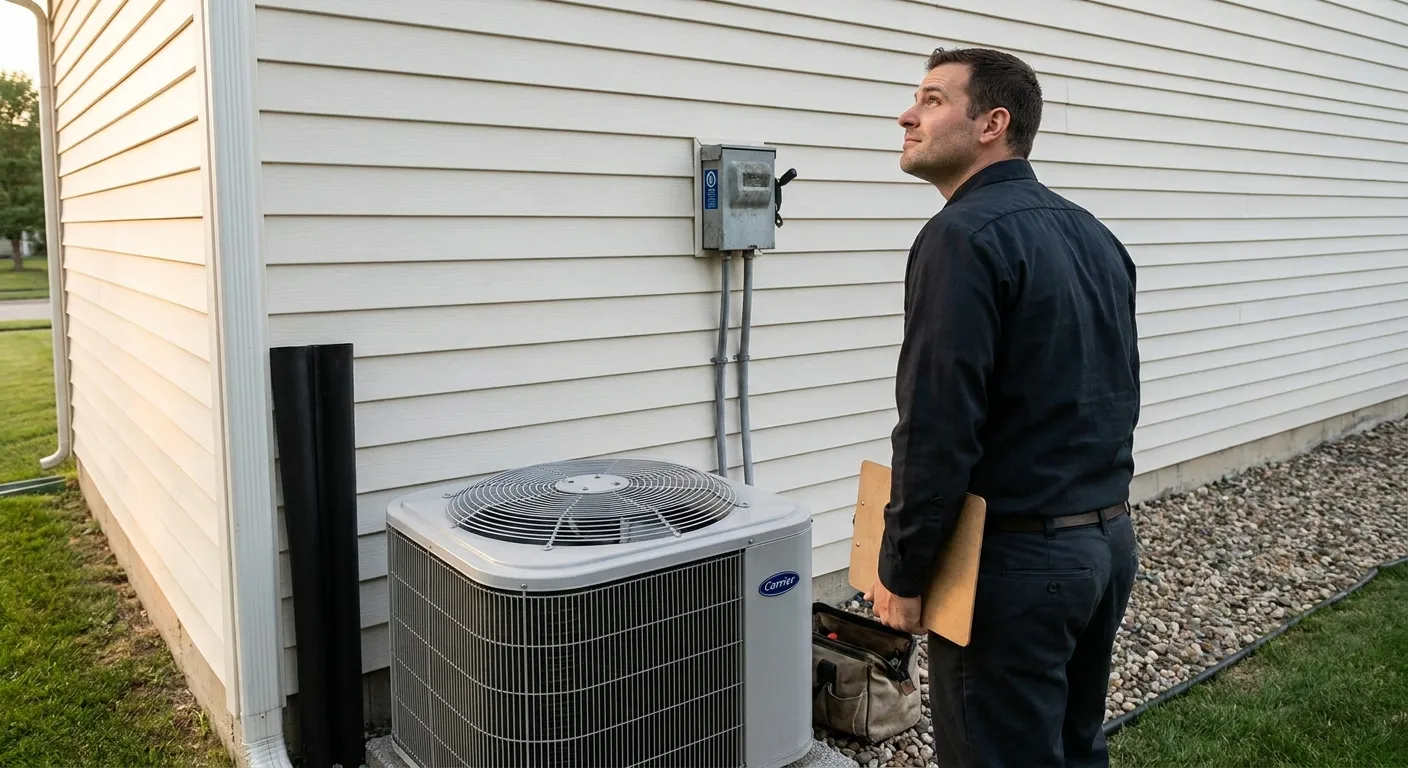
What does the 2023 NEC require for a residential heat pump?
A residential air-source heat pump pulls in seven NEC sections in install order: 310.16 sizes the conductor, 440.32 sets branch-circuit ampacity from nameplate MCA, 440.22 caps the overcurrent device at MOCP, 440.14 puts the disconnect within sight of the outdoor unit, 422.31 handles the air-handler disconnect, 210.8(F) requires GFCI on the outdoor outlet in 2020-NEC-and-later cycles, and 220.83 runs the retrofit load calc.
The short definition for each, in install order:
- NEC 310.16 — ampacity tables for insulated conductors. The 75 °C copper column is where almost every residential branch conductor gets read.
- NEC 440.32 — branch-circuit conductor ampacity at 125 % of rated-load current. The nameplate MCA already bakes this in.
- NEC 440.22 — branch-circuit overcurrent protection. MOCP is the ceiling. Pick the next standard size at or below.
- NEC 440.14 — disconnecting means location. Within sight from and readily accessible at the air-conditioning or refrigerating equipment.
- NEC 422.31 — appliance disconnect rules. Covers the indoor air handler.
- NEC 210.8(F) — outdoor outlets for dwelling units require GFCI in 2020 NEC and forward.
- NEC 220.83 — existing-dwelling Optional Method add-load calc. The retrofit path on a heat-pump add-on.
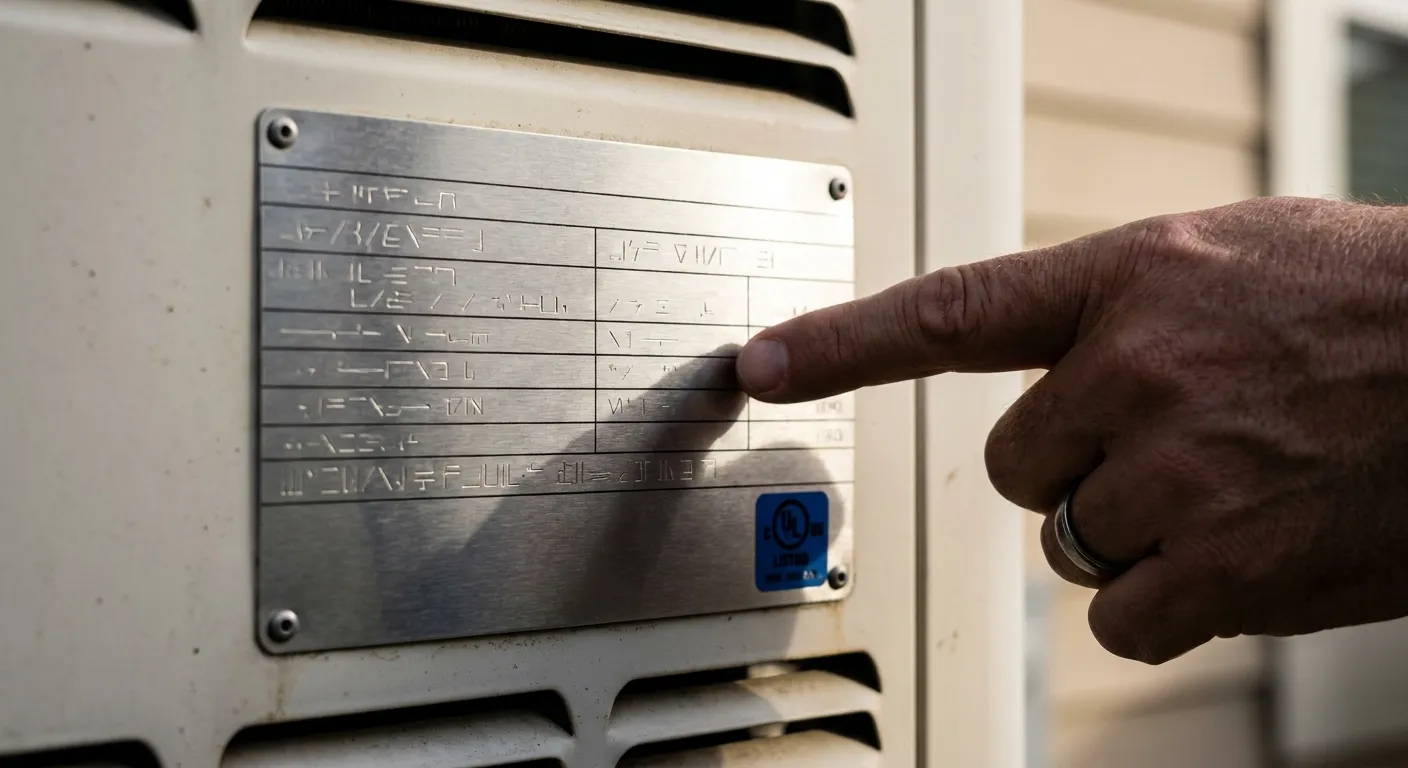
Package and ground-source units use similar logic but follow the manufacturer's installation manual for branch-circuit specifics. Everything below uses an air-source split as the worked example.
The worked example for this whole guide is a Carrier 25HCE6 family 4-ton air-source split. The nameplate reads MCA 28 A, MOCP 45 A, 208 / 240 V single-phase compressor. Indoor air handler with 10 kW auxiliary strip heat sits on a separate branch.
How do you read MCA and MOCP off the nameplate?
MCA is minimum circuit ampacity. It sizes the conductor. MOCP is maximum overcurrent protection. It caps the breaker. On the Carrier 25HCE6 sample, MCA reads 28 A and MOCP reads 45 A at 208 / 240 V single-phase, which is the spec for a 4-ton air-source split published in the Carrier product data sheet (Carrier 25HCE6 Product Data, 2024).
Two reads off the nameplate, two different jobs.
MCA already includes the 125 % continuous-load factor that NEC 440.32 (2023) requires on the compressor rated-load current. The OEM did the math and printed the answer. Do not multiply by 80 % again on top of MCA. That is the most common error on this calc, and the one that lights up the Mike Holt forum every spring.
MOCP is the absolute ceiling on overcurrent protection. NEC 440.22 (2023) allows the device at or below MOCP, never above. Pick the next standard size from NEC 240.6(A) at or below MOCP. On this nameplate MOCP is 45 A (a standard size), so the breaker lands at 45 A. If MOCP fell between standard sizes (say 47 A), you round down to 45 A, not up to 50 A.
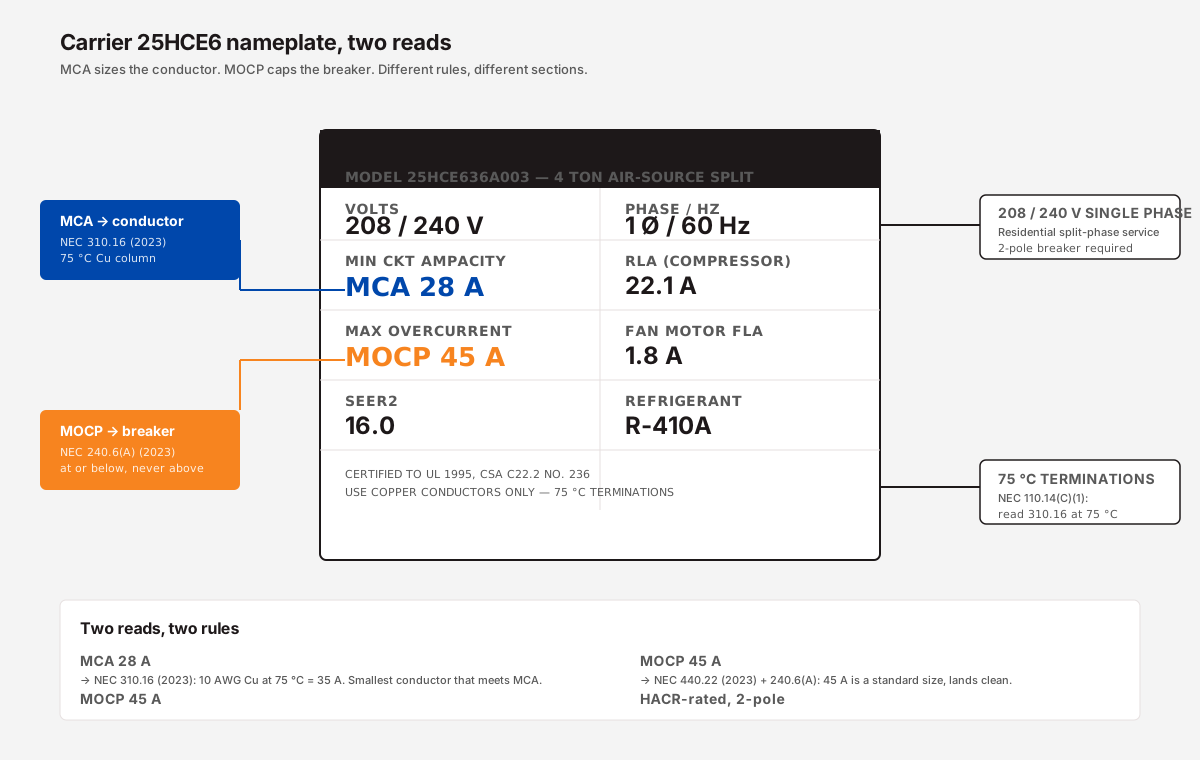
Two reads, two rules. MCA goes to 310.16 to pick a conductor. MOCP goes to 240.6(A) to pick a breaker. Keep them on separate lanes in your head and the rest of the calc falls out.
How do you size the branch-circuit conductor? (NEC 310.16, 440.32)
You take nameplate MCA, walk it to the 75 °C copper column of NEC Table 310.16 (2023), and pick the smallest conductor whose ampacity meets or exceeds MCA. For the Carrier 25HCE6 example, MCA 28 A reads as 10 AWG copper THHN at the 75 °C column (35 A ampacity), which is the standard pick on a residential 4-ton air-source split per NEC Table 310.16 (2023).
Why the 75 °C column when THHN is rated 90 °C? Because NEC 110.14(C)(1) (2023) caps ampacity at the lowest-rated termination in the circuit. Almost every residential breaker, lug, and disconnect terminal is rated for 75 °C. Read at 75 °C unless you have verified every termination is rated 90 °C. On residential equipment, you have not.
So MCA 28 A → 75 °C copper column → 10 AWG copper at 35 A. The next size up (8 AWG, 50 A) is overspec. The next size down (12 AWG, 25 A) does not meet MCA.
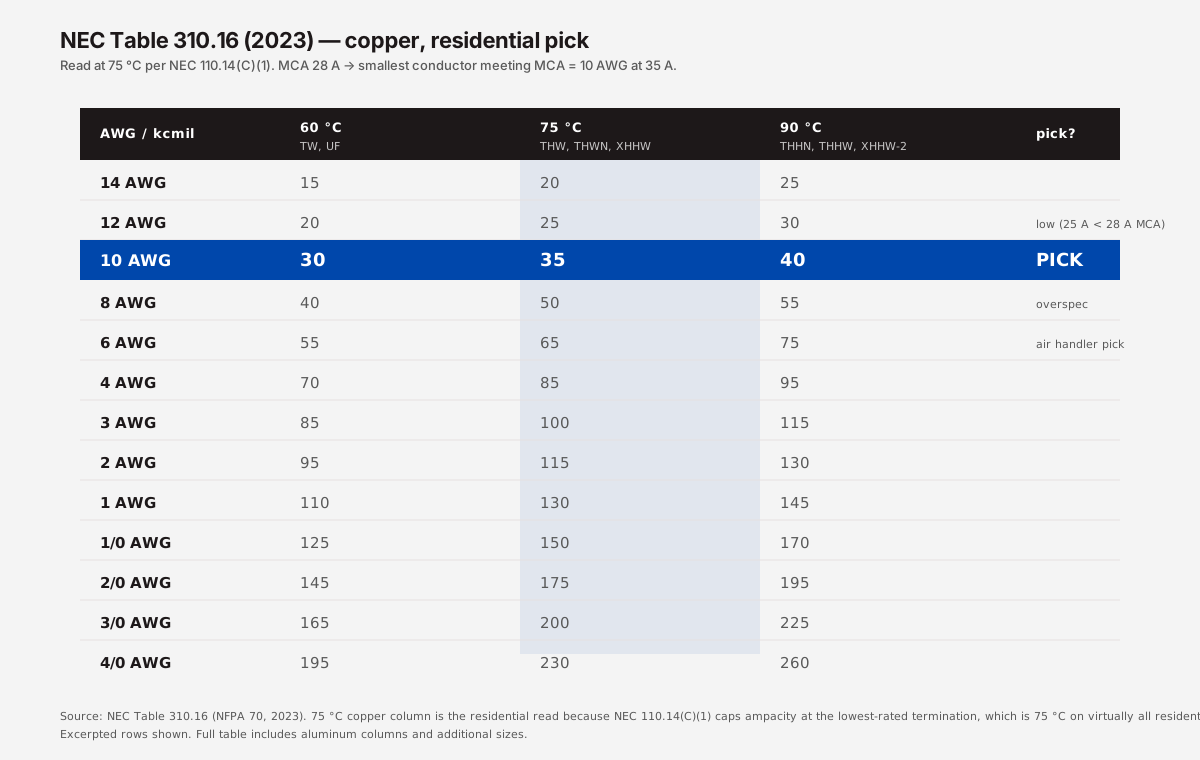
For the broader walkthrough on conductor sizing, see the full conductor-sizing walkthrough. For this article, MCA 28 A → 10 AWG copper at 75 °C is the answer.
One field note. On a long run (over 100 ft from panel to outdoor unit), voltage-drop checks sometimes push to 8 AWG. Voltage drop is not a NEC requirement on branch circuits, only a recommendation. Check it anyway. A heat pump that nuisance-trips at startup because of voltage sag is a callback you do not want.
What size breaker does a heat pump need? (NEC 440.22)
You size the breaker at or below the nameplate MOCP, never above. For the Carrier 25HCE6 MOCP 45 A, the breaker lands at 45 A, HACR-rated. MOCP is the ceiling per NEC 440.22(A) (2023), and the next standard size at or below from NEC 240.6(A) (2023) is the pick. On this nameplate, 45 A is already a standard size, so it lands clean.
The HACR rating matters. Per NEC 440.22(C), branch-circuit overcurrent protection for hermetic refrigerant motor-compressors must be HACR-rated. Most modern residential breakers (Square D HOM, Eaton CH, Siemens QP) carry HACR ratings as standard, but confirm on the carton before install.
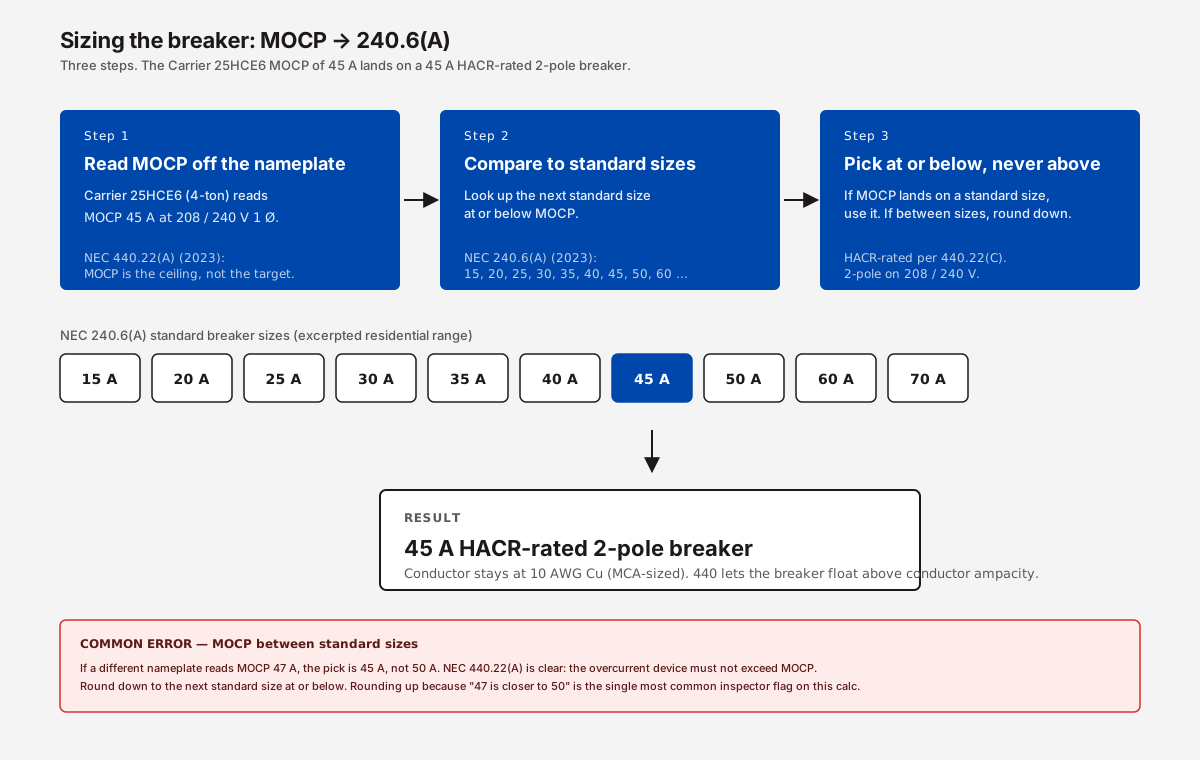
The common error here is picking the breaker at MOCP when MOCP falls between standard sizes. MOCP 47 A on a different unit brackets at 45 A and 50 A. You pick 45 A, not 50 A. NEC 440.22(A) is clear that MOCP is the ceiling and the device must not exceed it.
One more nuance. The breaker is HACR-rated and sized to MOCP, but the conductor is still sized to MCA. On the Carrier example, that means 10 AWG copper on a 45 A breaker. That looks wrong from general-purpose branch-circuit work where conductor and breaker move together. On a hermetic motor-compressor circuit, NEC 440 lets the breaker float above the conductor's normal 310.16 rating because the motor's locked-rotor inrush is the design driver, not steady-state ampacity.
Where does the disconnect go? (NEC 440.14, 422.31)
The outdoor disconnect lives within sight of and readily accessible from the outdoor unit per NEC 440.14 (2023). "Within sight" is defined in NEC Article 100 as visible and not more than 50 ft away. The typical install on a Carrier 25HCE6 is a 60 A non-fused weatherproof pullout disconnect mounted on the exterior wall, 18 to 24 inches off the pad and to one side of the compressor so the service tech has clean access.
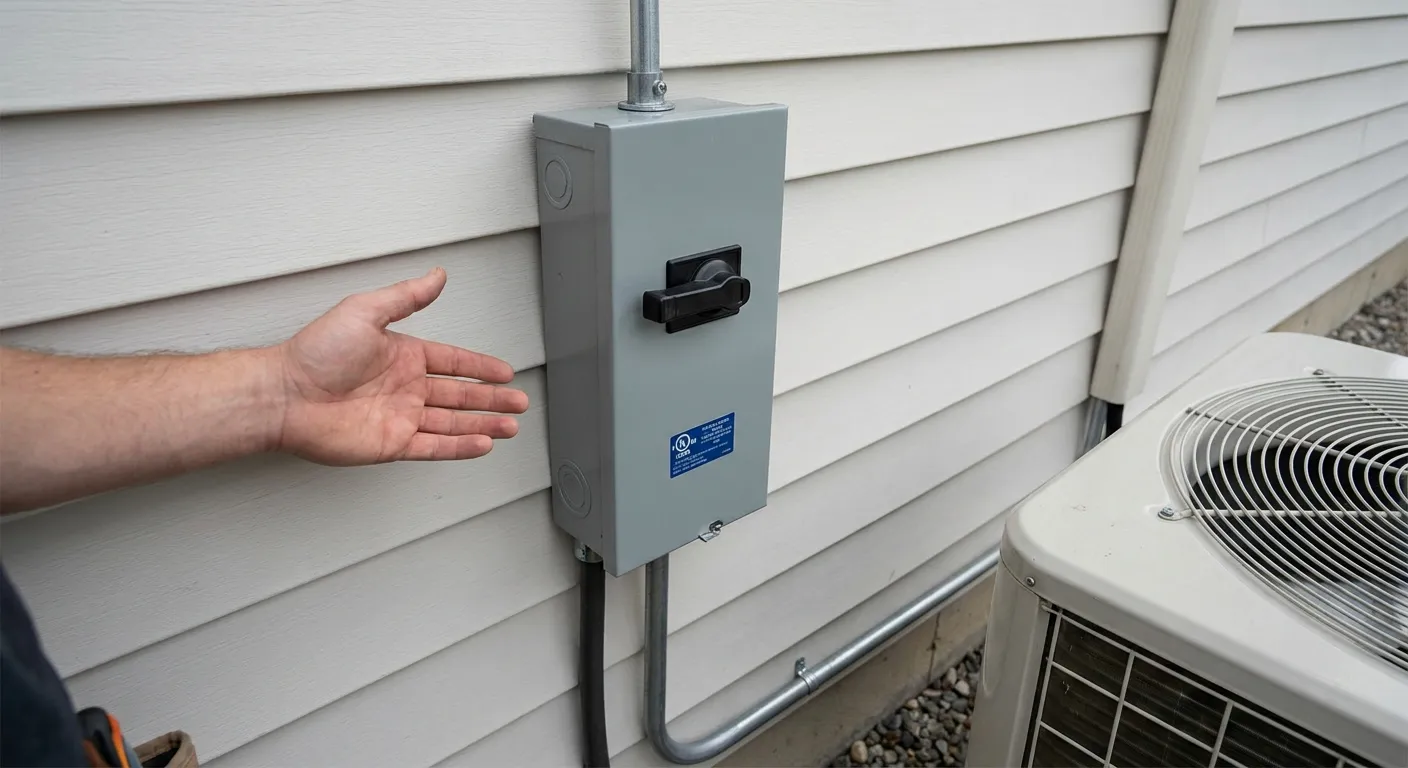
A few field rules that catch installers.
Behind the unit does not count. NEC 440.14 specifies readily accessible, which means no reaching past the equipment to operate the handle. Side wall or adjacent wall, 4 to 6 ft AFF on the operating handle.
The receptacle on the same outdoor wall (often required by NEC 210.63 within 25 ft of the HVAC unit, 2023) is a separate item from the disconnect.
The indoor air-handler disconnect runs under NEC 422.31 (2023). On a typical residential install where the air handler is in an attic or closet and the panel is in the garage, the panel breaker is not within sight of the air handler, so a separate disconnect at the air handler is required. A 60 A non-fused indoor pullout works.
If you need the exact wording on 440.14 for an AHJ that interprets "within sight" strictly, look up NEC 440.14 in the Breakerbox code lookup. I have run into one jurisdiction that asks for the disconnect within 6 ft (stricter than the NEC 50 ft) as a local amendment.
Does an outdoor heat pump need GFCI? (NEC 210.8(F))
Yes, in 2020 NEC and 2023 NEC jurisdictions, the outdoor outlet that supplies an HVAC outdoor unit on a dwelling unit must have GFCI protection per NEC 210.8(F). The 2020 cycle added the rule. The 2023 cycle clarified scope after the nuisance-trip controversy. Roughly 70 % of US states had adopted 2020 NEC or later as of late 2025 (NFPA NEC Adoption Map, 2025), which means most jurisdictions are inside the rule today.
2017 vs 2020 vs 2023 NEC delta
NEC 210.8(F) did not exist in the 2017 cycle. The 2020 cycle introduced it and required GFCI protection on outdoor outlets for dwelling-unit HVAC equipment. After the 2020 release, nuisance-trip complaints with variable-frequency-drive compressors triggered TIA 20-2, which delayed enforcement of 210.8(F) in some adopting states. The 2023 cycle retained 210.8(F) with clarified scope language and adjusted GFCI listing requirements. Net rule for an electrician working in 2026: assume 210.8(F) applies unless your AHJ is documented as still on 2017 NEC. The minority of jurisdictions still on the 2017 cycle are the only ones outside the rule.
The most common callback on a heat-pump install over the last three years is the 210.8(F) miss after a 2020 NEC adoption. The inspector flags the outdoor circuit on first review, and the install has to come back out to swap the breaker for a GFCI breaker. That is one return trip you can avoid by speccing the GFCI on the first pass.
The cleanest spec is a 2-pole GFCI breaker at the panel feeding the outdoor branch. Square D, Eaton, and Siemens all make them in 45 A. The 2023 cycle requires the GFCI to be self-test capable and listed for the load type. Some VFD compressors still struggle with first-generation GFCIs, so check the compressor manufacturer's compatibility notes. The Carrier 25HCE6 family is documented as compatible with standard 2-pole GFCI breakers.
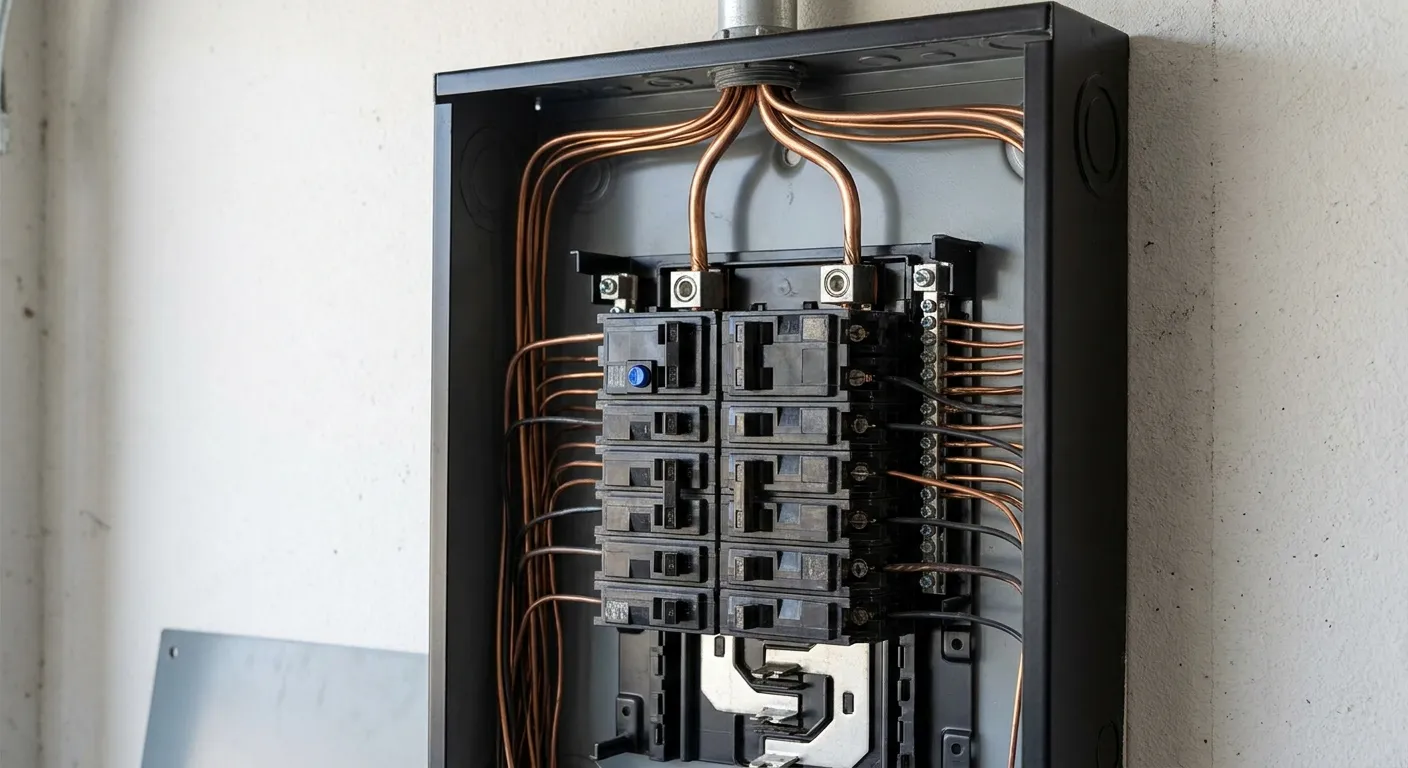
Some states adopt the cycle and amend out 210.8(F) specifically. If you are unsure whether your AHJ kept the rule on adoption, check the AHJ adoption in the code lookup before you write the spec.
Will the existing panel carry a heat pump? (NEC 220.83)
You run NEC 220.83 (2023), the Optional Method for adding loads to an existing dwelling, to confirm the existing service can absorb the new heat pump. On a 1980s 2,200 sq ft ranch with a 150 A service, a 4-ton air-source split at 28 A MCA on the compressor and a 10 kW strip-heat air handler lands well under the 120 A safe continuous capacity of a 150 A service. Most retrofits on a 150 A or 200 A service pass the calc with headroom.
220.83 is the right path when the existing-load inventory is verifiable from the panel directory. Use NEC 220.82 (2023) when the inventory cannot be trusted. Use NEC 220.87 (2023) when the AHJ accepts a year of utility max-demand data. Most retrofit heat-pump jobs run 220.83.
Worked example on the existing 1980s ranch:
| Line | NEC ref | Raw VA |
|---|---|---|
| General lighting (2,200 sq ft × 3 VA) | 220.12 (2023) | 6,600 |
| Small-appliance circuits (2 × 1,500) | 220.52(A) | 3,000 |
| Laundry circuit (1 × 1,500) | 220.52(B) | 1,500 |
| Range (nameplate) | 220.83 | 10,000 |
| Dryer (nameplate, min 5,000) | 220.83 | 5,000 |
| Water heater | 220.83 | 4,500 |
| Dishwasher | 220.83 | 1,200 |
| Disposal | 220.83 | 1,000 |
| Other-loads subtotal (no HVAC) | 32,800 |
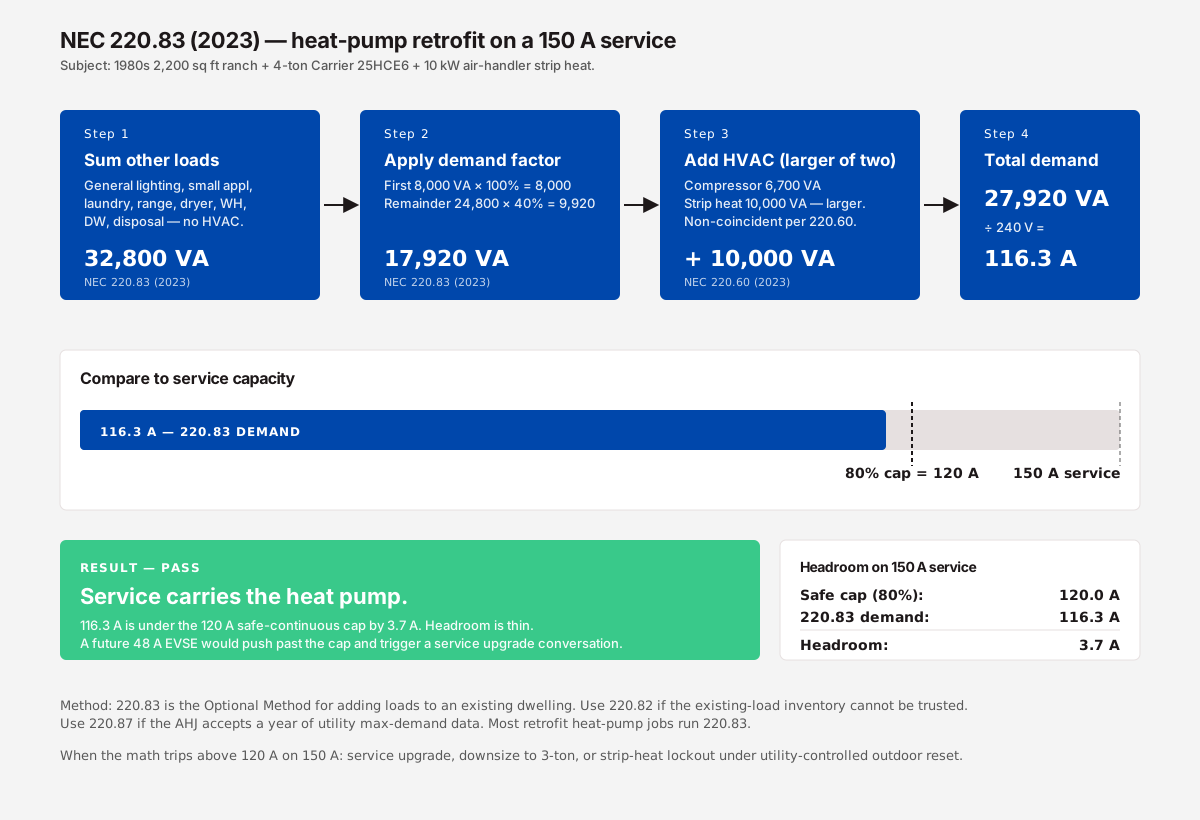
Apply 220.83 demand factor (2023): first 8,000 VA at 100 %, remainder at 40 %.
- First 8,000 × 100 % = 8,000
- Remainder 24,800 × 40 % = 9,920
- Other-loads demand = 17,920 VA
Add HVAC at 100 % per 220.83. NEC 220.60 (2023) lets you take the larger of two non-coincident loads. Compressor running load on a 4-ton air-source at the Carrier 25HCE6 nameplate is roughly 6,700 VA (28 A MCA × 240 V, adjusted for the MCA inflation factor). Strip-heat lockout backup is 10 kW = 10,000 VA. Take the larger. HVAC demand = 10,000 VA.
220.83 total demand = 17,920 + 10,000 = 27,920 VA
Convert: 27,920 VA ÷ 240 V = 116.3 A.
Compare to 80 % of 150 A safe continuous capacity = 120 A.
116.3 A is under 120 A by a small margin. The service passes 220.83 with the heat pump added, but the headroom is thin. If the customer plans a 48 A EVSE in the next 18 months, the same panel will not carry both. For that decision the EV charger load calculation walkthrough runs the same approach on the EV side.
You can run the 220.83 calc in the Breakerbox Load Calculator on your own inputs, with 220.83 and 220.82 side-by-side and an AHJ-ready PDF export. For the general-purpose load-calc method reference, see the residential load-calculation walkthrough.
When the math trips above 120 A on a 150 A service, the next conversation is a service upgrade, a 3-ton heat pump instead of 4-ton if cooling capacity allows, or strip-heat lockout under utility-controlled outdoor reset.
What about the air-handler and auxiliary strip-heat branch?
The indoor air handler with auxiliary strip heat is a separate dedicated branch circuit, sized off the air-handler nameplate, not off the compressor nameplate. On the Carrier 25HCE6 paired with a matched fan-coil and 10 kW strip heat, air-handler max-amps reads roughly 49 A and max-breaker reads 60 A at 240 V. That puts the air-handler branch on 6 AWG copper at 75 °C and a 60 A HACR breaker.
Every competing article on this query ignores the second branch. A working install has two.
The math on the air-handler side runs the same way as the compressor side. Read max-amps and max-breaker off the air-handler nameplate. Max-amps to the 75 °C copper column of 310.16. Max-breaker to NEC 240.6(A). On 10 kW strip heat plus the blower at 240 V, max-amps lands around 49 A, so 6 AWG copper (65 A at 75 °C) is the conductor and 60 A is the breaker.
NEC 424.3(B) (2023) treats fixed electric space-heating as continuous at 125 %, but the air-handler max-amps nameplate value already bakes the 125 % factor in. Size to nameplate. On the service calc the strip heat and compressor are non-coincident under NEC 220.60 (2023) and the calc takes the larger.
End-to-end worked example: the Carrier 25HCE6 on a 150 A panel
Stitching it together on one job. Subject: Carrier 25HCE6 4-ton air-source split with matched indoor air handler and 10 kW strip heat. Existing 1980s 2,200 sq ft ranch on a 150 A service. The full electrical scope reads:
Outdoor compressor branch. 10 AWG copper THHN on a 45 A 2-pole HACR-rated GFCI breaker (NEC 310.16, 440.22, 210.8(F)). 60 A non-fused weatherproof pullout disconnect on the exterior wall within sight of the compressor (NEC 440.14).
Indoor air-handler branch. 6 AWG copper THHN on a 60 A 2-pole HACR-rated breaker (NEC 310.16, 440.22). 60 A non-fused indoor pullout at the air handler when the panel is not within sight (NEC 422.31).
Service capacity check. 220.83 demand with the heat pump added = 27,920 VA = 116.3 A versus 120 A safe continuous (80 % of 150 A). Pass with 3.7 A headroom.
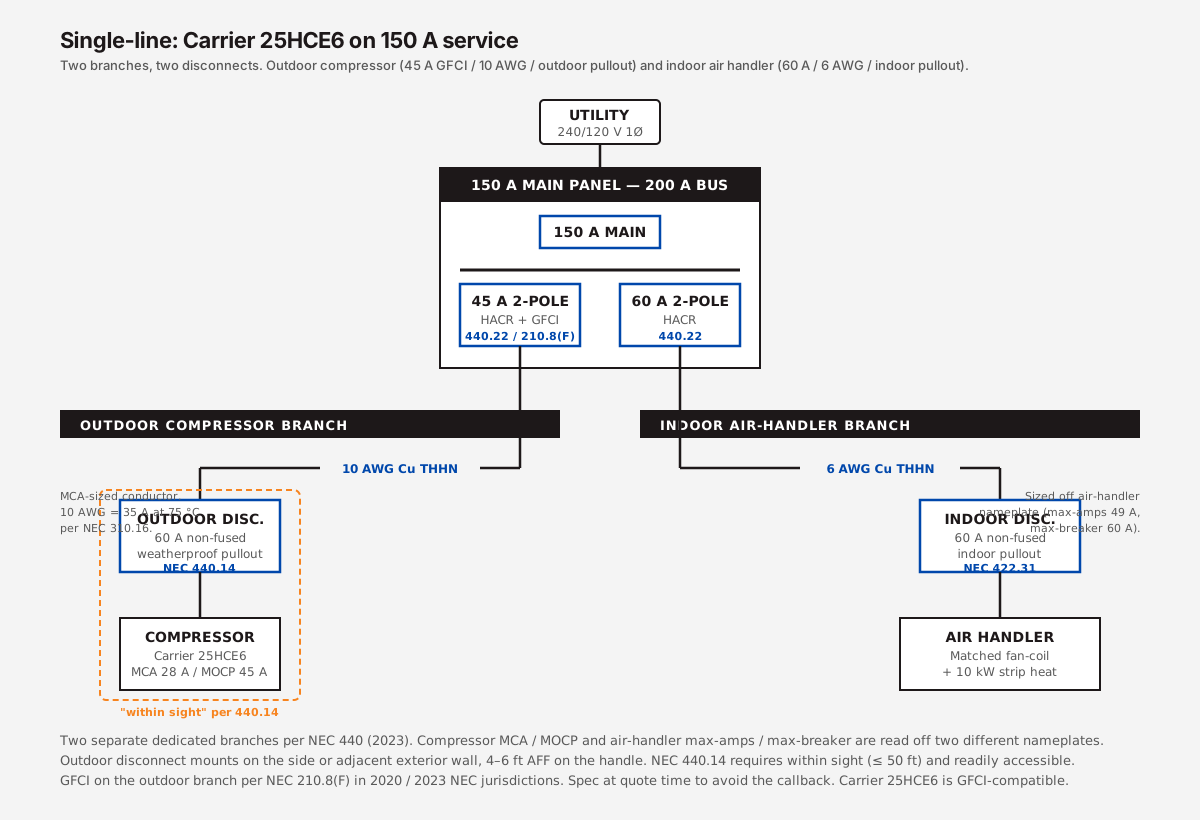
That is the entire install in one diagram. Two breakers, two branches, two disconnects, one 220.83 stamp. No service upgrade on this job. If the customer adds a Level 2 EVSE later, the calc gets rerun against the new combined load.
Common code-violation pitfalls on heat-pump installs
The five callbacks I see most often on heat-pump retrofits
- Applying 80 % derate on top of MCA. MCA already includes the 125 % continuous factor per NEC 440.32. Multiplying again undersizes the breaker conversation and oversizes the conductor.
- Picking the breaker at MOCP when MOCP is between standard sizes. MOCP 47 A rounds down to 45 A under NEC 440.22(A), not up to 50 A. Inspector flag on first review.
- Outdoor disconnect installed behind the compressor. NEC 440.14 requires readily accessible. Behind the unit means moving the unit to operate the disconnect. Fail.
- Missing 210.8(F) GFCI on the outdoor branch in 2020+ NEC jurisdictions. Single most common callback in 2024–2026. Spec the GFCI breaker at quote time.
- Sizing the air-handler branch off the compressor nameplate. Two separate nameplates, two separate branches. Air-handler max-amps and max-breaker are not the same numbers as compressor MCA / MOCP.
Catch the five at quote time and the install runs clean.
Frequently asked questions
Does a heat pump need its own breaker?
Yes. NEC 440 (2023) requires a dedicated branch for the outdoor compressor and a separate branch for the indoor air handler. Two 2-pole breakers at the panel is the standard residential install.
What size breaker do I need for a heat pump?
Size the breaker at or below nameplate MOCP per NEC 440.22 (2023). The Carrier 25HCE6 4-ton with MOCP 45 A lands on a 45 A HACR-rated breaker (GFCI in 2020+ NEC jurisdictions, per NEC 210.8(F)). When MOCP falls between standard NEC 240.6(A) sizes, round down, never up.
How many amps does a 3-ton heat pump use?
A typical residential 3-ton air-source split lands at MCA 20 to 28 A at 208 / 240 V single-phase, depending on manufacturer and SEER tier. The 4-ton Carrier 25HCE6 reads MCA 28 A. Size to nameplate, never to tonnage. Two 3-ton units from different OEMs can pull different amperages.
Can I run a heat pump on a 100-amp panel?
Sometimes, after a 220.83 calc. A small dwelling with limited other loads and a 2.5- or 3-ton heat pump can fit. A 2,200 sq ft dwelling with electric range, dryer, water heater, and a 4-ton heat pump almost always trips the 80 A safe continuous cap on a 100 A service. Run the calc to find out.
Do heat pumps require GFCI?
In 2020 NEC and 2023 NEC jurisdictions, the outdoor outlet for the compressor requires GFCI protection per NEC 210.8(F). The 2017 cycle did not have the rule. Most US states had adopted 2020 NEC or later by late 2025 (NFPA NEC Adoption Map, 2025). Spec the GFCI breaker on the first pass to avoid the callback.
What to do next
You have the seven NEC sections, the Carrier 25HCE6 nameplate worked end to end, and the 220.83 stamp on a 150 A retrofit. The install is a 45 A GFCI HACR on 10 AWG to the outdoor disconnect, plus a 60 A HACR on 6 AWG to the air-handler disconnect.
For your own job, drop the dwelling, the loads, and the nameplate into the Breakerbox Load Calculator for the 220.83 number and an AHJ-ready PDF. For an AHJ that interprets a section oddly in your area, check the cycle in the Breakerbox code lookup.
Anchored to: 2023 NEC (NFPA 70). The 210.8(F) GFCI delta from 2017 to 2020 to 2023 is called out in the GFCI section.