
If you searched "single line diagram" looking for the power-engineer's flow-study reference, this guide isn't that. This one's for the electrician who got a plan-review comment back from the AHJ saying "submit an SLD" and now has to figure out what that means on a 200A service upgrade, an EV charger, or a solar interconnect.
TL;DR: A single line diagram (SLD) is a one-line schematic that shows every major piece of an electrical system, source, service entrance, OCPDs, conductors, grounding, and loads, with each multi-conductor circuit drawn as a single line. On a permit set it's the page the plan reviewer flips to first. This guide covers the symbols, how to read one top to bottom, when an electrician has to produce one (service upgrades ≥ 200A, EV chargers with panel work, solar tie-ins), and how the rules in the 2023 NEC and your local AHJ shape what has to appear on the page. "Single line" and "one line" are the same drawing, the terms are synonyms in every authoritative source.
A quick disclosure: This guide reflects the 2023 NEC. Plenty of AHJs are still on the 2020 cycle and a few on 2017, so confirm the adopted code in your jurisdiction before you stamp anything. I'm Jack Simpson, co-founder at Breakerbox and an electrical engineer who's drawn SLDs for residential service upgrades, EV installs, and small commercial fit-outs under all three cycles. We make the Breakerbox Line Diagram tool, and the companion load calculation walkthrough covers sizing the service this SLD will document.
What is a single line diagram?
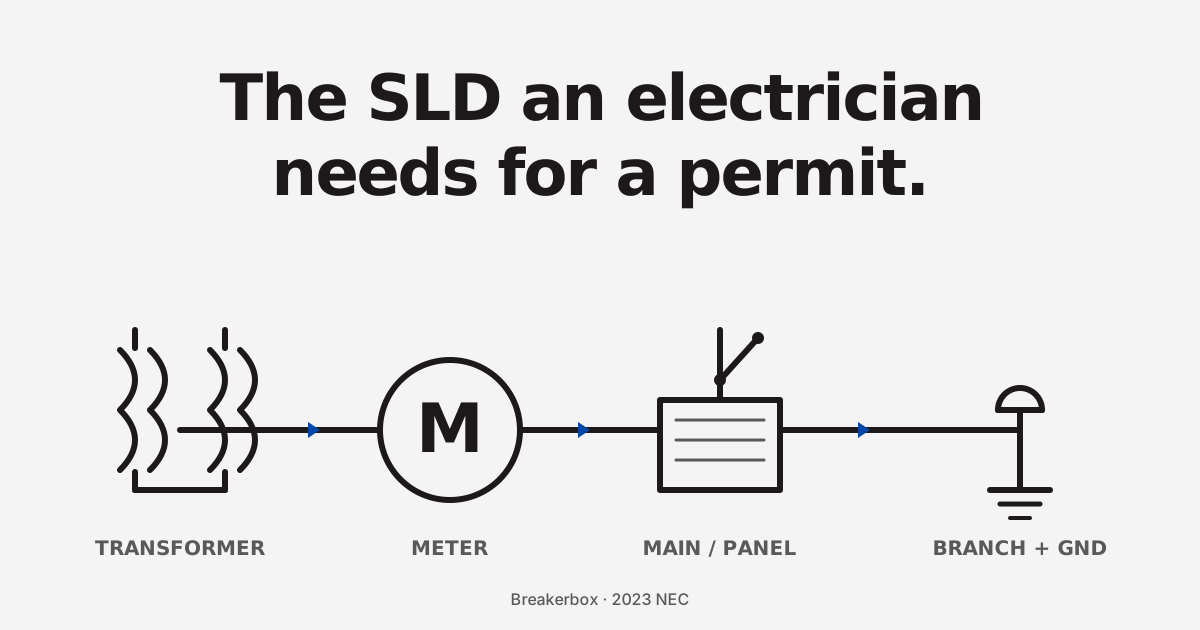
A single line diagram is a simplified schematic of an electrical system where each set of conductors, whether 2-wire, 3-wire, or 4-wire, is drawn as a single line. It shows the path power takes from the source through every overcurrent device, transformer, switch, and major load. Electricians submit one with permits so the AHJ can verify the system's topology, conductor sizing, and grounding at a glance.
That definition is the heart of it. The trick that throws people the first time is the "one line represents multiple conductors" part. On a 120/240V residential service the SE conductors are physically three wires (two hots and a neutral) plus a grounding electrode conductor, but on the SLD that whole bundle is one line, with the conductor count, size, and material called out in a label beside it.
The terminology question comes up every time. "Single line diagram" and "one line diagram" are the same drawing. Wikipedia, IEEE, NEMA, and every authoritative reference treat the terms as interchangeable. If your plan reviewer writes "submit a one-line" and the utility's interconnect packet asks for an "SLD," they're asking for the same thing.
What an SLD is not: it isn't a wiring diagram (which shows physical terminations and individual conductors), it isn't a three-line diagram (which draws each phase separately for protection coordination), and it isn't a panel schedule (which lists branch circuits in a table). Those each live on their own sheets of the permit packet. Comparison table further down.
What symbols appear on a single line diagram?
The symbols come from two standards that have been merged in practice: IEEE 315 (graphic symbols for electrical and electronics diagrams) and ANSI Y32.2 (the older legacy version of the same). Most AHJs will accept either, and the variant symbols that show up on utility-prepared drawings (a transformer drawn as two interlocking circles vs. two stacked coils, for instance) don't generally trip plan review as long as the device is labeled.
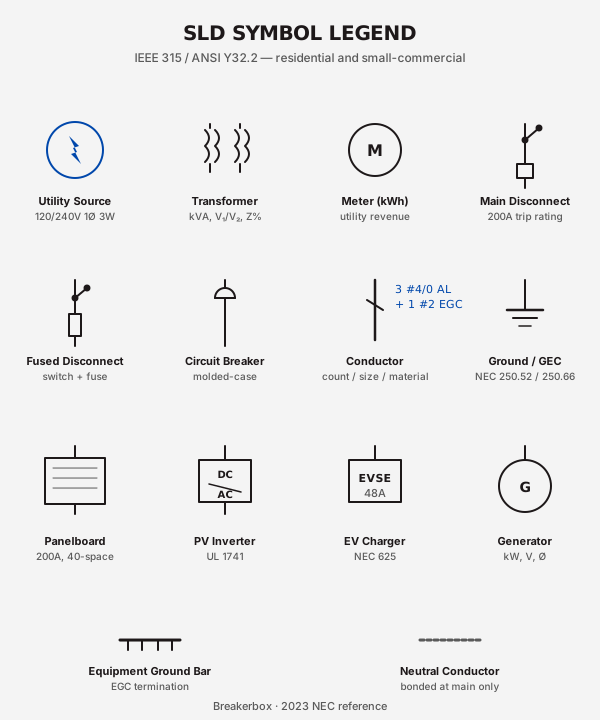
The dozen symbols above are the ones that show up on 95% of residential and small-commercial SLDs. A short field guide:
- Utility source. Drawn as a lightning arrow or a labeled circle marked "POCO" or with the service voltage (e.g., 120/240V 1Ø 3W). It anchors the top of the diagram.
- Transformer. Two interlocking or stacked coils. On the residential side this is often the pad-mount or pole-pig the POCO owns, drawn for context only. On commercial work the building transformer is on the customer side and the SLD has to specify kVA, primary/secondary voltage, and impedance.
- Meter. A circle with "M" or "kWh." On combined meter-mains it's drawn integral with the main disconnect.
- Main disconnect / main OCPD. Drawn as a switch or breaker symbol with the trip rating labeled (e.g., 200A, 60A). The plan reviewer's eye lands here first.
- Fused disconnect. Switch in series with a fuse symbol. Common on solar AC disconnects and the inverter's DC side.
- Circuit breaker. A semicircle (molded-case) or an X-in-a-box (general). Branch-circuit breakers on a residential SLD are usually summarized in the panel schedule rather than drawn individually, the SLD shows the feeder breaker, not every 20A circuit.
- Conductor. A straight line, with a label beside it specifying count, size, type, and conduit (e.g., "3 #4/0 + 1 #2 EGC in 2" PVC"). NEC 110.14 conductor terminations and 310.16 ampacity tables drive the sizes.
- Ground / grounding electrode. Three downward-stepped lines (earth ground) or a triangle. Grounding electrode conductor (GEC) sizing comes from NEC 250.66.
- Panelboard. A rectangle labeled with bus rating, voltage, and feed-through configuration.
- PV inverter. A rectangle with "DC/AC" or "INV." UL 1741 listing is called out in a note.
- EV charger. Often labeled "EVSE" with the input current. NEC 625 governs.
- Generator. A circle with "G" or "GEN," with kW and voltage labeled.
Conductor sizing on the SLD pulls from NEC 220 (load calc), 310 (ampacity), and 250 (grounding). The cross-pillar wire ampacity tables verify the size on any labeled line.
How do you read a single line diagram?
Read top to bottom, source to load. Every SLD that hits a plan reviewer's desk follows the same orientation: utility (or generator/PV) at the top, the main service equipment in the upper third, the panelboard and any subpanels in the middle, and the major loads at the bottom. If you find an SLD that runs sideways or bottoms-up, somebody drew it for a presentation slide, not a permit.
Here's the six-step pass an electrician runs on an unfamiliar SLD:
- Find the source. Almost always top-left or top-center. Note service voltage, phase, and wire configuration (120/240V 1Ø 3W is the residential default; 208Y/120V 3Ø 4W is the small-commercial default).
- Trace to the meter. Verify it's drawn upstream of the main OCPD. If it's not, the SLD is wrong, NEC 230.66 and the local utility tariff dictate metering location.
- Identify the main disconnect / main OCPD. Note the rating. This is the number the AHJ pulls to verify against the load calc submitted on the same packet.
- Read the SE conductor label. The line between the meter and the main panel will carry a conductor callout. Compare to NEC 310.12 (residential 120/240V services) or 310.16 (general ampacity).
- Walk the panelboard's feeds. Subpanel feeders, large dedicated branch circuits (range, dryer, HVAC, EV, PV interconnect), and any backfed breakers (for PV or generator) should each be drawn. Branch-circuit breakers under 30A typically don't appear, they're on the panel schedule instead.
- Confirm the grounding. The GEC and the grounding electrode system (ground rod, water pipe, Ufer/concrete-encased electrode per NEC 250.52) should be drawn, with the GEC size labeled. Plan reviewers flag missing or undersized GECs as one of the most common SLD rejection reasons (see the LADBS Residential Electrical Plan Check correction list and the Seattle DCI electrical permit tips for the published checklists).
Self-contained answer: Where do you start reading a single line diagram? Start at the source (utility, generator, or PV array) at the top of the page and work down to the loads. Each line you cross is a conductor or a circuit; each symbol is a device. Verify the service voltage and phase at the top, the main OCPD rating in the upper third, and the GEC/grounding electrode system at the bottom-left of the service equipment block.
A full-detail wiring diagram gives you the contrast: wiring diagrams show every termination, SLDs hide them inside the device symbols.
When does an electrician need a single line diagram?
The honest answer is "whenever the AHJ asks for one," and the AHJ asks for one any time the service topology is changing or a new significant load is being interconnected. There's no national rule that says "every permit needs an SLD," and per NEC §80.9 the AHJ has plenary authority over what plan-set documents are submitted. But there's a pretty consistent pattern across jurisdictions for when an SLD shows up on the required list.
The four job types where you should plan on producing an SLD before you even pull the permit:
- Service upgrade ≥ 200A. Any time the service-entrance equipment is being replaced or the service amperage is being increased, the AHJ wants to see the new topology. Jurisdictions like Seattle DCI, LADBS, and Austin DSD publish this on their residential electrical permit checklists.
- EV charger install with panel work. A simple 40A EVSE on an existing panel with spare capacity might pass on a one-line annotated panel schedule. The moment you're adding a subpanel, doing a load-management installation (NEC 750), or bumping the service to feed the EVSE, the SLD is required. NYC DOB EV installation guidance is explicit about this for any EV install over 50A.
- Solar / storage interconnection. Required in nearly every jurisdiction. NEC 705.10 mandates a permanent placard indicating the location of every PV disconnect, and the utility interconnection packet requires an SLD showing the PV system tie-in (line-side tap, supply-side connection, or load-side breaker per NEC 705.12).
- Multifamily and small commercial work. Any time you have more than one service or feeder leaving the metering, you're on an SLD. Period.
Adjacent triggers worth flagging: panel relocations, ATS (automatic transfer switch) for generator installs, and any time a current transformer (CT) cabinet is involved. Each one changes the service-equipment topology, and the AHJ wants the new state drawn.
A downloadable panel schedule template ships alongside the SLD in nearly every one of these submissions; together they are what the plan reviewer uses to verify the load calc.
For the EV-specific picture: when an EV install requires a panel upgrade covers when the panel and SLD have to be redrawn vs. when a load-management install lets you stick with the existing service. The NEC 625 EV charger code requirements piece is the code-detail companion.
Single line diagram examples by job type
Three worked SLDs that match the job-type triggers above. Each one is annotated, the callouts explain what each element is and why it's on the diagram. These are reading exercises, not drafting tutorials.
Residential service upgrade (100A to 200A)
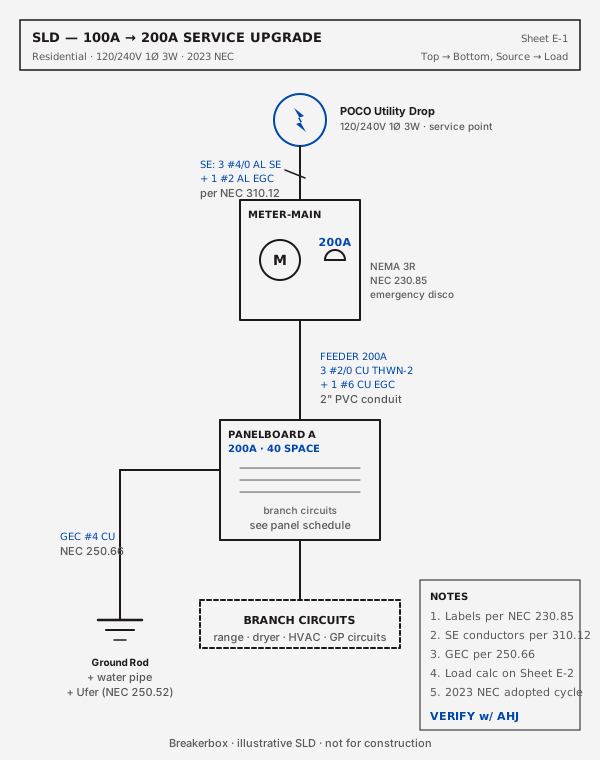
On a 200A service upgrade I've submitted in Seattle and Austin, this is the SLD layout the plan reviewer expects. The reading order matches the six-step pass above. Top to bottom:
- Utility drop / service point. Labeled 120/240V 1Ø 3W. The service-point demarcation is the POCO's responsibility upstream, the customer's downstream.
- Combination meter-main, 200A. Single enclosure, NEMA 3R for outdoor mount. The "M" circle plus the 200A breaker symbol indicate the combined unit. This is the most-common modern residential install because it satisfies the NEC 230.85 emergency disconnect requirement (2020 cycle onward) without a separate disconnect.
- SE conductors. Labeled "3 #4/0 AL SE + 1 #2 AL EGC" or equivalent. The conductor size is pulled from NEC Table 310.12 for a 200A residential service.
- 200A indoor panelboard. 40 spaces typical. The feeder from the meter-main to the panel is drawn as a single line with a "200A" rating and the conductor callout.
- GEC. #4 AWG copper to the grounding electrode system (ground rod and water pipe), sized per NEC 250.66.
- Branch circuits. Summarized as a labeled rectangle "see panel schedule." The full enumeration lives on the panel schedule sheet.
The single most-common plan-review hit on this SLD: missing or undersized GEC. The second most common: meter-main labeled "200A" but the SE conductor callout sized for 150A. Match the numbers.
EV charger install (Level 2, dedicated branch, with subpanel)
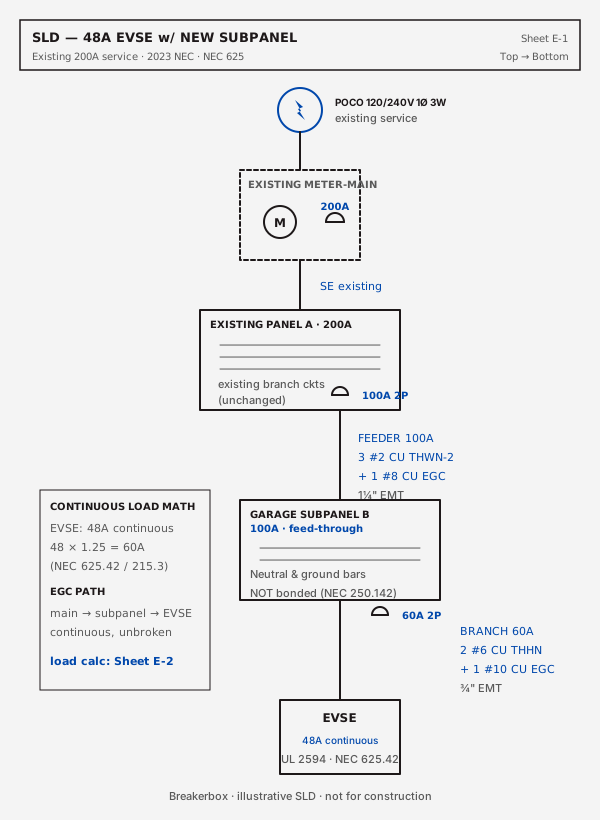
This is the version I've drawn for a 48A continuous-load EVSE on an existing 200A service routed through a new garage subpanel. The reading order:
- Existing service equipment. Drawn for context, the meter-main and main panel are shown so the plan reviewer can verify the existing service is rated for the new load. NEC 625.42 requires the load calc to include the EVSE at 125% of rated current (48A × 1.25 = 60A continuous).
- Feeder to the new subpanel. 100A feeder breaker in the main panel feeds a 100A subpanel in the garage. Conductor callout: "3 #2 CU THWN-2 + 1 #8 CU EGC in 1¼" EMT" or similar.
- Garage subpanel. 100A bus, fed-through configuration. The neutral and ground bars are bonded only at the main, not the subpanel (NEC 250.142).
- EVSE branch. 60A two-pole breaker, conductor callout "2 #6 CU THHN + 1 #10 CU EGC in ¾" EMT." The EVSE itself is labeled with its rated input current and the UL listing (UL 2594 for EVSE; UL 916 if it's a smart EVSE that's also functioning as load management hardware).
- Equipment grounding. Continuous EGC from main panel through subpanel to the EVSE chassis.
The plan-review hits to expect here: the EVSE labeled with continuous current but the conductor sized at non-continuous ampacity (NEC 215.3 says continuous loads at 125%). And missing the load calc reference on the title block.
Solar / storage interconnection (load-side breaker, 200A panel)
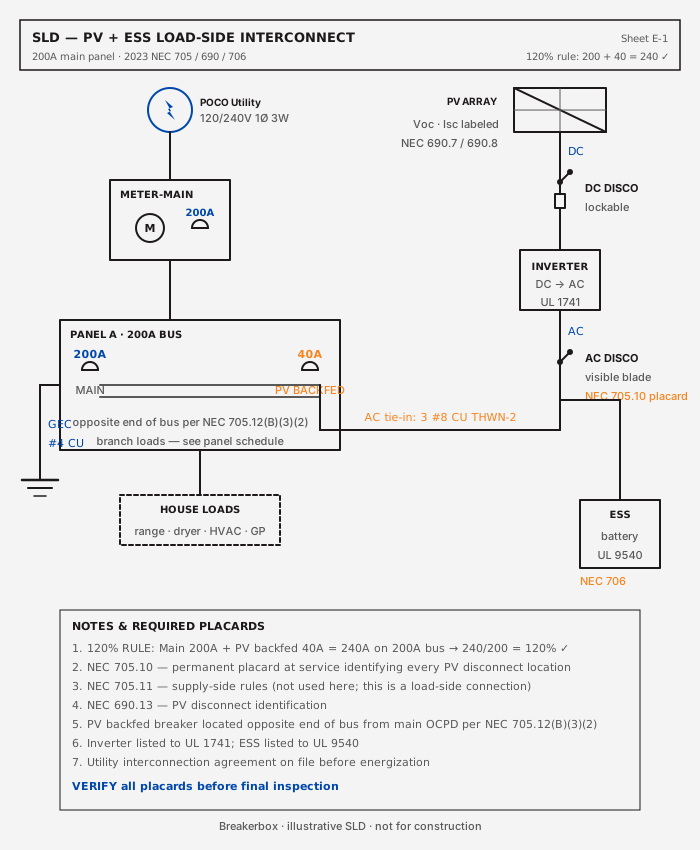
The solar SLDs I've prepared for utility interconnect packets all follow this same pattern, and it's the densest of the three because two sources (utility and PV) are now feeding a single bus under NEC 705. Reading order top to bottom on the AC side, then back up the DC side:
- Utility source. Same as the service-upgrade example. 200A meter-main, 200A main OCPD.
- Main panelboard, 200A. Backfed breaker for the PV inverter sits at the opposite end of the bus from the main OCPD (NEC 705.12(B)(3)(2), the "120% rule" placement requirement on a load-side connection).
- AC disconnect. Lockable, visible-blade, labeled "PV AC DISCONNECT." NEC 705.10 requires a permanent placard at the service identifying the location of every PV disconnect.
- Inverter. Rated AC output current labeled. UL 1741 listing called out.
- DC side, going back up. PV string combiner, DC disconnect, PV array. Each string's open-circuit voltage and short-circuit current is labeled for the AHJ to verify against NEC 690.7 and 690.8 (Voc / Isc calculations).
- Battery storage. ESS (energy storage system) drawn either AC-coupled (separate inverter, parallel to the PV inverter on the AC bus) or DC-coupled (on the DC bus before the PV inverter). UL 9540 listing on the ESS, NEC 706 governs.
- System labels. A note on the SLD title block listing the required NEC 705.10, 705.11, and 690.13 placards. Plan reviewers love when this is on the SLD itself, it saves them having to flip to the label-schedule sheet.
The 120% busbar rule (NEC 705.12) is the math the plan reviewer is doing in their head when they see this SLD. Main breaker (200A) + backfed PV breaker (let's say 40A) = 240A on a 200A bus. 240A ÷ 200A = 120%. If your PV breaker pushes that ratio over 120%, you're in a busbar derate, a line-side tap (NEC 705.12(A)), or a supply-side connection. The solar load calculation walkthrough covers the math.
Single line vs. one line vs. wiring vs. three-line diagrams
Same drawing, different drawings, sometimes confusing. Here's the comparison:
| Diagram type | What it shows | Conductor representation | Who reads it | When you use it |
|---|---|---|---|---|
| Single line diagram | System topology: source → OCPDs → conductors → loads | One line per circuit, regardless of conductor count | AHJ plan reviewer, utility, electrician | Permit submission, service upgrade, EV/solar interconnect |
| One line diagram | Identical to single line (synonyms) | One line per circuit | Same audience | Same triggers |
| Wiring diagram | Physical terminations, every individual conductor, color coding | Every conductor drawn separately | Installer, troubleshooter | Service work, replacing equipment, troubleshooting a fault |
| Three-line diagram | Each phase of a three-phase circuit drawn separately, including PTs/CTs and relay connections | Three lines per circuit (one per phase) | Protection engineer, commissioning tech | Protection coordination studies, large commercial/industrial, utility metering |
| Panel schedule | Branch circuit list with breaker sizes, descriptions, loads | Tabular, no graphic | AHJ, electrician | Always paired with the SLD on a permit set |
| Circuit diagram (schematic) | Logic/control circuits, often for a single device or system | Symbolic (not physical layout) | Engineer, designer | Equipment design, control system documentation |
The two practical takeaways: (1) Single-line and one-line are the same thing, the AHJ asking for one or the other isn't asking for two documents. (2) The SLD and the panel schedule are siblings on a permit set, neither one stands alone. The electrical panel schedule walkthrough covers the sibling document.
A note on the three-line. On residential and most small-commercial permits you'll never need one. They show up on protection-coordination studies for commercial/industrial gear with relays, and on utility metering installs over 600A. If a plan reviewer asks you for a three-line on a residential service upgrade, push back politely, that's not the document they want.
How do you create a single line diagram for a permit?
Short section, because the full drafting walkthrough for a one line diagram covers the title-block layout, symbol-library choices, and render-for-AHJ steps. This part is just what the finished SLD has to contain.
Every permit-ready SLD has these elements on the page:
- Title block. Project address, scope, date, designer/electrician of record with license number, sheet number, and NEC cycle.
- Source identification. Utility name, service voltage, phase, wire configuration, available fault current (if the AHJ requires it).
- Service equipment. Meter, main OCPD with trip rating, SE conductor callout with size/material/insulation/conduit.
- Panelboard(s). Bus rating, voltage, feed-through or main-breaker configuration, location.
- Major loads. Anything over 30A, anything continuous, every appliance with a dedicated circuit (range, dryer, water heater, HVAC, EV, PV, ESS).
- Grounding. GEC size and grounding electrode system components (rods, water pipe, Ufer) per NEC 250.
- System labels and placards. Required NEC labels in a notes block (705.10/.11 for PV, 230.85 for emergency disconnects).
- References. NEC cycle called out explicitly. Load calc reference (sheet number or attachment).
For the drawing itself, common paths: AutoCAD or Bluebeam Revu for shops with a CAD license, purpose-built tools like the Breakerbox Line Diagram tool or Kopperfield for shops without, or general-purpose wiring diagram tools and broader schematic editors for shops that want a flexible toolkit.
Frequently asked questions
What is a single line diagram used for?
A single line diagram is used to document an electrical system's topology, source, service equipment, OCPDs, conductors, grounding, and major loads, in a single simplified drawing. Electricians submit one with permits so the AHJ can verify the design at a glance. Engineers also use them for power-flow studies, short-circuit analysis, and arc-flash calculations on commercial and industrial systems.
What is the difference between a single line diagram and a one line diagram?
There's no difference. The terms are synonyms. Wikipedia, IEEE, NEMA, and every authoritative electrical reference treat "single line diagram" and "one line diagram" as the same drawing. If a plan reviewer writes "submit a one-line" and the utility's interconnect packet asks for an "SLD," they're asking for the same document.
What is the difference between a single line diagram and a wiring diagram?
A single line diagram shows system topology with each circuit drawn as a single line, regardless of how many conductors are in it. A wiring diagram shows every physical conductor and every termination point. SLDs are for permit submission and overall design review; wiring diagrams are for installation and troubleshooting. A plan reviewer wants the SLD, a service tech in the field wants the wiring diagram.
What symbols are on a single line diagram?
Standard SLD symbols come from IEEE 315 and ANSI Y32.2. The dozen you see on most residential and small-commercial diagrams: utility source, transformer, meter, main disconnect, fused disconnect, circuit breaker, conductor (with size/material label), ground, panelboard, PV inverter, EV charger, generator. Conductor callouts (count, size, type, conduit) are essential, the symbol alone isn't enough.
Do I need a single line diagram for a solar or EV permit?
Solar and battery storage interconnections require an SLD in nearly every jurisdiction. NEC 705 governs the interconnection and the utility's packet requires the drawing. EV chargers depend on scope: a simple plug-in EVSE on an existing panel may pass on a one-line panel schedule, but anything involving a service upgrade, a subpanel, load management (NEC 750), or a charger over about 50A will trigger an SLD requirement.
How do I read a single line diagram?
Read top to bottom, source to load. Find the utility source at the top, note the service voltage and phase, identify the main OCPD and its rating, read the SE conductor callout, walk down through the panelboard to subpanels and major loads, and confirm the grounding at the bottom-left of the service equipment block. Every line you cross is a circuit, every symbol is a device.
What software do electricians use to draw a single line diagram?
Common options: AutoCAD or Bluebeam Revu (for shops with existing CAD licenses), purpose-built tools like Kopperfield or the Breakerbox Line Diagram product (for shops without), and general-purpose schematic editors like draw.io or Eraser DiagramGPT. For permit work specifically, a tool with a built-in IEEE 315 symbol library and an editable title block saves hours over a blank-canvas drawing tool.
Why do AHJs reject single line diagrams?
The three most common rejection reasons across published AHJ checklists (LADBS, Seattle DCI, Austin DSD, NYC DOB): missing or undersized grounding electrode conductor; conductor callouts that don't match the OCPD rating (200A main with 150A SE conductor labels, e.g.); and missing required NEC placards/labels referenced on the SLD (NEC 705.10 for PV, 230.85 for emergency disconnects, 110.16 for arc-flash on commercial gear).
What is a three-line diagram and when do I need one instead?
A three-line diagram draws each phase of a three-phase circuit separately, including instrument transformers (PTs and CTs) and relay connections. It's used for protection-coordination studies on commercial and industrial systems, and for utility metering installs over 600A. On residential and small-commercial permits, you won't need one. If a plan reviewer asks for a three-line on a residential job, push back, that's not the right document.
Is a single line diagram the same as an electrical schematic?
No. A schematic shows the logical or control structure of a circuit, often for a single device or control system. An SLD shows the power topology of an entire electrical system. The two are related (both are simplified, both use symbols) but they answer different questions.
What to do next
If you got here because a plan reviewer asked for an SLD and you weren't sure what they meant, you should now know: it's the system-topology drawing, single line per circuit, source at the top, loads at the bottom, GEC at the bottom-left, conductor callouts everywhere. Find the closest match to your job in the worked examples above and use the symbol legend to read your own permit packet's SLD page.
If you're documenting a service upgrade, run the load calc before you draw, because the load calc result is what drives every conductor and OCPD rating you're going to put on the page.
The Breakerbox Line Diagram tool is purpose-built for the permit-ready SLD: IEEE 315 symbol library, residential and small-commercial templates for the three job types above, editable title block with NEC cycle and license fields. Same approach as the load calculator, it's the tool we built because the alternatives weren't fitting the electrician-permit workflow.